

When Veere Grenney purchased a double-fronted Georgian house in central London, it hadn’t been updated since World War Two and required a complete redesign. To many, such an overhaul would have proven daunting, but Grenney – a New Zealand-born decorator whose classically inspired style has established him as a leading arbiter of taste – was delighted with the opportunity to redo the four-storey property from top to bottom.
‘The great thing about designing your own home is it’s exactly as you want it to be,’ says Grenney, who left a comfortable childhood in Auckland behind to travel across land from Singapore to London, where he opened an antiques stall in Notting Hill’s Portobello Road Market. After training under Mary Fox Linton and David Hicks, he became a director at the interior decorating firm Sibyl Colefax & John Fowler – a defining experience he credits with instilling a deep appreciation for premium quality and tailoring. In 1996 Grenney founded his eponymous company, and has since brought his refined aesthetic to residential projects that range from a sprawling country estate in Oxfordshire, England, to a bamboo beach house on an island in the Caribbean.
‘On a classical level, it’s usually about symmetry and order,’ he says of the careful attention to harmony that runs through his designs. Due to its 19th-century architecture, his London property already possessed an innate sense of symmetry that Grenney sought to complement with a strong colour palette and a sumptuous selection of fabrics. In the drawing room, the walls are upholstered in a luxuriant shade of green silk velvet, chosen by Grenney for the way it flatters the pale blue sofa and assortment of gilded picture frames. ‘I always think that it’s great to be brave with colour,’ says Grenney of his decision to embrace darker shades. ‘You very much have ownership over what you’re doing.’
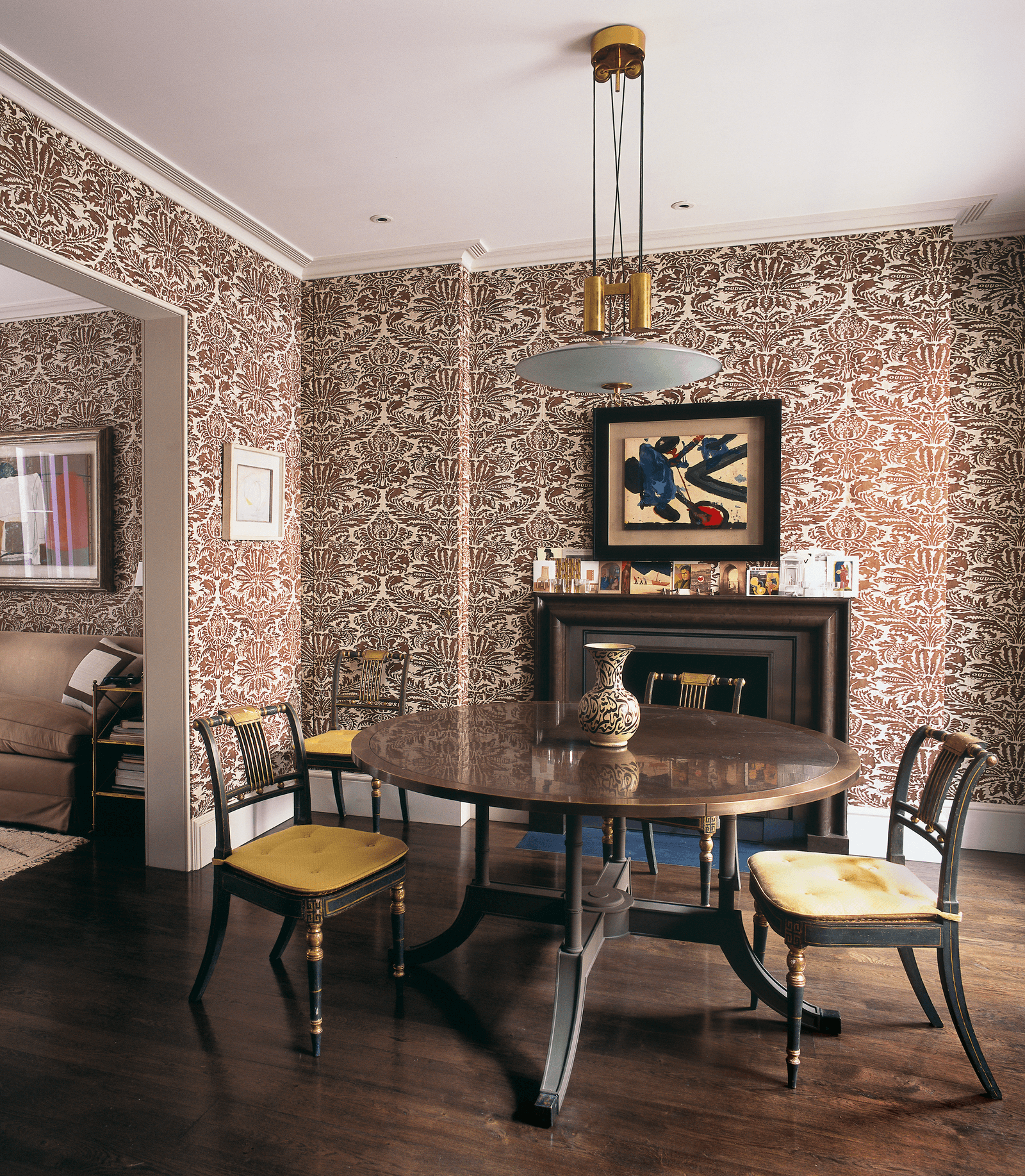
He also upholstered an interconnecting dining room and library – this time in a hand-blocked Fortuny fabric with a Venetian pattern inspired by a design from the 15th century. A custom-made dining table was commissioned to perfectly fit the dimensions of the space, while Grenney’s collection of artworks – largely English postwar painters – are displayed on the walls.

The primary suite was bedecked in white linen and gold silk trimming, from the drapes around the four-poster bed to the matching curtains. A lack of cupboards led Grenney to transform a small room on the floor below into a dressing room that features a bed cosily framed by ochre-coloured cashmere curtains. ‘I love the idea of creating niches of beds,’ says Grenney. ‘It’s like a child, you know – children love making huts under tables, so it’s got that element.’
Since Grenney decorated the house 12 years ago, it’s remained untouched. ‘At the moment, I love it the way it is,’ he says, noting that further additions to his property portfolio, such as a villa in Tangiers, Morocco, have allowed him new canvases to experiment on. ‘I think it’s always very nice to make things unique for yourself, and cosy, which is what a house is all about.’
Extracted from Inside: At Home with Great Designers, published by Phaidon, £39.95 (phaidon.com)
- Lucy Williams brings her signature sense of style to her west London house
- The 30-year evolution of Lucinda Chambers' London house
- An interior designer’s perfect chocolate-box cottage in the Cotswolds
- Catherine FitzGerald and Dominic West's home in Ireland
- A cowshed in rural France transformed in to a stylish home by the owners of Pinch


