


Most of our Christmas traditions – including Christmas markets, Christmas trees, and Advent calendars – have come from Germany and Austria. As any of us who’ve been there in December know, there’s a particular magic to Christmas in northern Europe; the air carries a different scent - of crisp snow, roasting chestnuts, and log fires - and there’s a quiet but palpable excitement in the streets. “It becomes a real winter wonderland,” remarks the House & Garden Top 100 interior designer Henriette von Stockhausen of VSP Interiors, who grew up in Munich, and has spent almost every Christmas of her life in a small village in Austria, high up in the mountain foothills of the Zugspitze. “It’s such a strong change of season from the summer, and there’s a romance to the snow.” Additionally, “the traditions are really important to everyone,” she explains. And while yes, we know many of them, there’s been some dilution in the UK, not to mention cross-pollination from American holiday films, which means that it’s worth examining them anew, in their pure state. For there are plenty of decorative ideas to pinch – and some rituals worth adopting.

Henriette explains that Christmas starts “at the beginning of Advent – that is, the first Sunday in Advent, with the lighting of the first candle in the Advent wreath which happens when the family come together for the main meal of the day, whether that is lunch of supper.” The concept was born in the 16th century and is highly symbolic: the circular shape represents God’s endless love, the evergreen leaves are for eternal life brought by Jesus Christ, and the candles symbolise hope, joy, love and peace. Another is lit every Sunday, until Christmas Day when the final and fifth candle – for Christ Himself – is also lit.
“Next is Krampusnacht, and St. Nicholas’s Day,” continues Henriette, “which is when it really starts to feel like Christmas is coming – and soon.” The former takes place on the evening of the 5th December, and involves men dressing up as the Krampus – a horned figure whose origins are found in Alpine folklore – and chasing children through the streets, while the feast day of St. Nicholas, who famously distributed his wealth to the poor, is on the 6th. As has so often happened, paganism and Christianity have intertwined to the extent that the Krampus and St. Nicholas now work together; “the children put their shoes out on the night of the 5th, and hope that it’s St. Nicholas who comes with presents, and not the Krampus with coal! St. Nicholas brings mainly chocolates and satsumas and nuts – there’s usually one present in there – but it might be socks or a book, it’s a little treat.”

Meanwhile, other preparations begin in earnest – among them, baking. “There are so many traditional biscuits and cakes,” says Henriette, mentioning stollen and lebkuchen, and “we bake our own gingerbread biscuits that get hung on the tree, each with the initial of someone in the family – the dogs and the ponies get them, too, so there are lots.” And, around the 20th of December each year, Henriette, her husband and her children drive out to Austria – whereupon communal baking starts, along with dressing the house.
“The decoration really starts when we get there,” she explains. “We decorate the fireplaces a little, with berries and branches, and put a wreath on the front door, but we don’t get the tree until about the 23rd, when we go and find it in the woods. It’s very simple.”

“We celebrate Christmas on the 24th, we all wear traditional dress, so dirndl and Austrian jackets, and we decorate the tree that morning with little red apples, and we spray nuts gold and hang them, and of course there are biscuits that we made. There’ll be Christmas music playing, and friends will come by and we’ll have gluhwein and something sweet to eat.” It’s also when the crib comes out, “though the baby Jesus doesn’t go in the manger until midnight that night,” explains Henriette. “We go to church in the afternoon of the 24th – and all the children of the village act out the nativity, and it’s candle lit just incredibly beautiful.”
“After that service, the evening of the 24th is when the Christkindl comes.” The word is literally translated as ‘Christ child’ - though according to Lutheran tradition he is an interpretation of Him, a sprite-like child, rather than an incarnation - and he is the main gift giver in southern Germany, Austria, Switzerland, and several other countries is central and eastern Europe. “It’s very exciting for the children, as throughout the day the Christkindl will leave signs that he’s in the area, maybe a strand of lametta on the stairs that we’ll find, so that we know that his arrival is imminent. Nearer the time we gather outside the drawing room where the tree is, and we wait and we wait – and then a bell is rung, meaning the Christkindl has been, and in we go, and the presents to the children from the Christkindl will be under the tree, and a window will be open, showing his exit.”
“Then, we gather around the tree, we sing Christmas songs, and we all open our presents before we have the Christmas meal. We have Champagne with smoked salmon on black bread, followed by fillet of roast beef with a Russian salad – which is potatoes, eggs, carrots, pickles, onions, peas and more, all with a mayonnaise-based dressing – though some Germans have goose, and some have carp. And then the grownups all go to midnight mass. On Christmas Day itself, the 25th, very little happens. We sit together, we have a relaxed breakfast, the children start playing with their toys, and then we go skiing.”

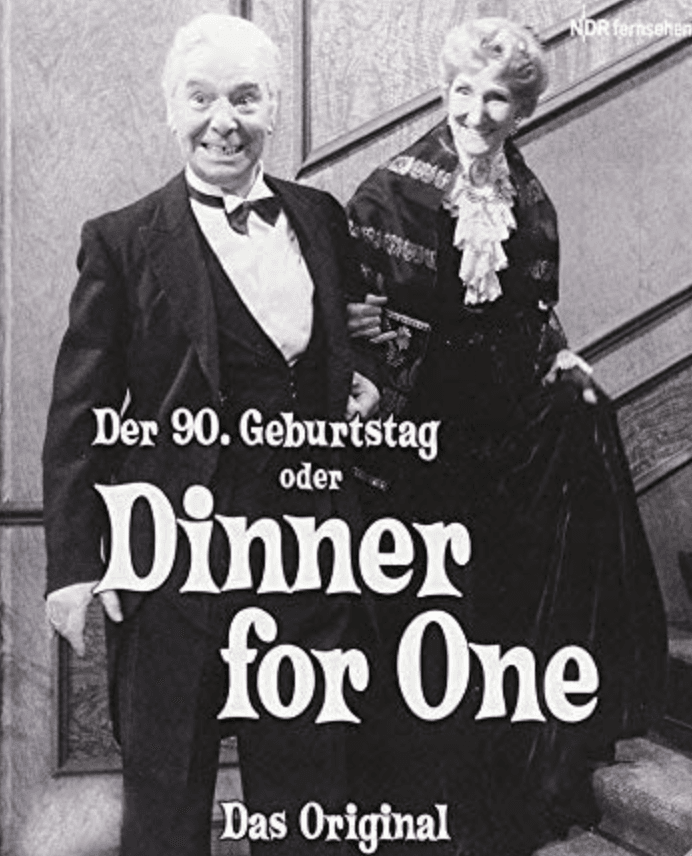
The next event is New Year, “and we have a fondue, which is easy, because nobody has to do much work for it.” But what also happens – and this, says Henriette, is vital to New Year, - is that everybody sits down to watch Dinner for One, a 1963 two-hander black and white comedy sketch, starring May Warden and Freddie Flinton. “It’s hysterical,” remarks Henriette. “It’s shown on German and Austrian television every year, it’s about a lady who makes her butler pretend to be every one of her friends in turn, while also being her butler, and he gets drunker and drunker. It’s slapstick, so funny, and none of my British friends even seem to know about it.” Except that we do, now, and happily it’s available on YouTube.
Finally, it is Epiphany, “when children come around the village, dressed as the three kings, and bless each house. The tree goes out that night,” says Henriette, who remarks that while each of these traditions is special, and each matters, “what is most important over the whole period is the togetherness, for grandparents and grandchildren, uncles and aunts, and other people in the village. It’s when we take the time to slow down and that is what makes it feel special. It’s a still time, a moment to reflect and think about the year gone past, and that’s what I really like about it.” Which, as we enter the typically frantic days ahead, is worth keeping in mind, and perhaps even trying to emulate.


