
A dream seaside house on Cap Ferret revived

The English owners of this picture-perfect beach house, Villa Isabelle, on Cap Ferret, near Bordeaux, had been holidaying on the peninsula for 10 years or so, casting the odd casual glance in the estate agent's window, but little more. Out of the blue, they got a call to say this house was for sale and they went the very next weekend, saw it on Saturday and signed for it on Sunday.
‘It was in an unspeakable state; it was as if it had been camped in rather than lived in, with only one bathroom and bare wires hanging down the walls,’ says one of the owners. It was also rotten. ‘You could stick your fingers through the walls in some places, and every window had to be replaced.’ But it was a house that everyone knew. Old pictures of it, when it was in its prime, had appeared in books on the Cap, and it was in the perfect position, its garden leading directly on to the owners’ favourite beach.
MAY WE SUGGEST: The pure, light-filled spaces of a Cornish house by Marion Lichtig
The house had been badly messed about but the couple found a local architect and builder, Guy Allemand, who could help them restore it to something closer to its former self, while also bringing it up to date for modern, beachside living. Guy started by removing the clumsy-looking terrace that had been added to the upper level, replacing it with something closer to that shown in old photographs, and incorporated part of the lower terrace into the house to create the sitting room. He also repainted the outside of the house in a summery palette. At the back of the house, separated from it by a courtyard, which becomes a lovely retreat from the beach when it's crowded, Guy built a three-bedroom guest house, ‘Isabeau’, in the style of a traditional fisherman’s cottage.
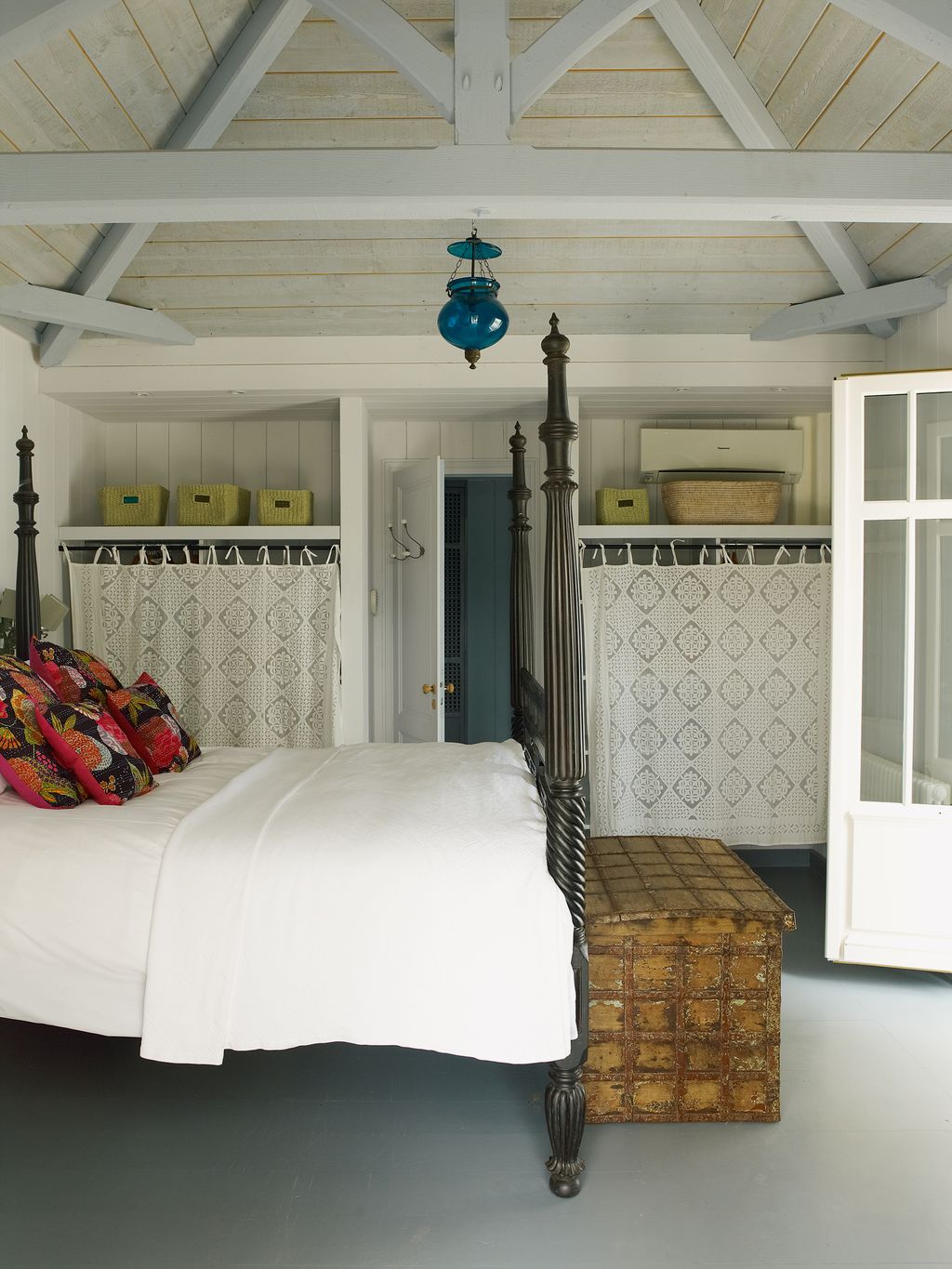
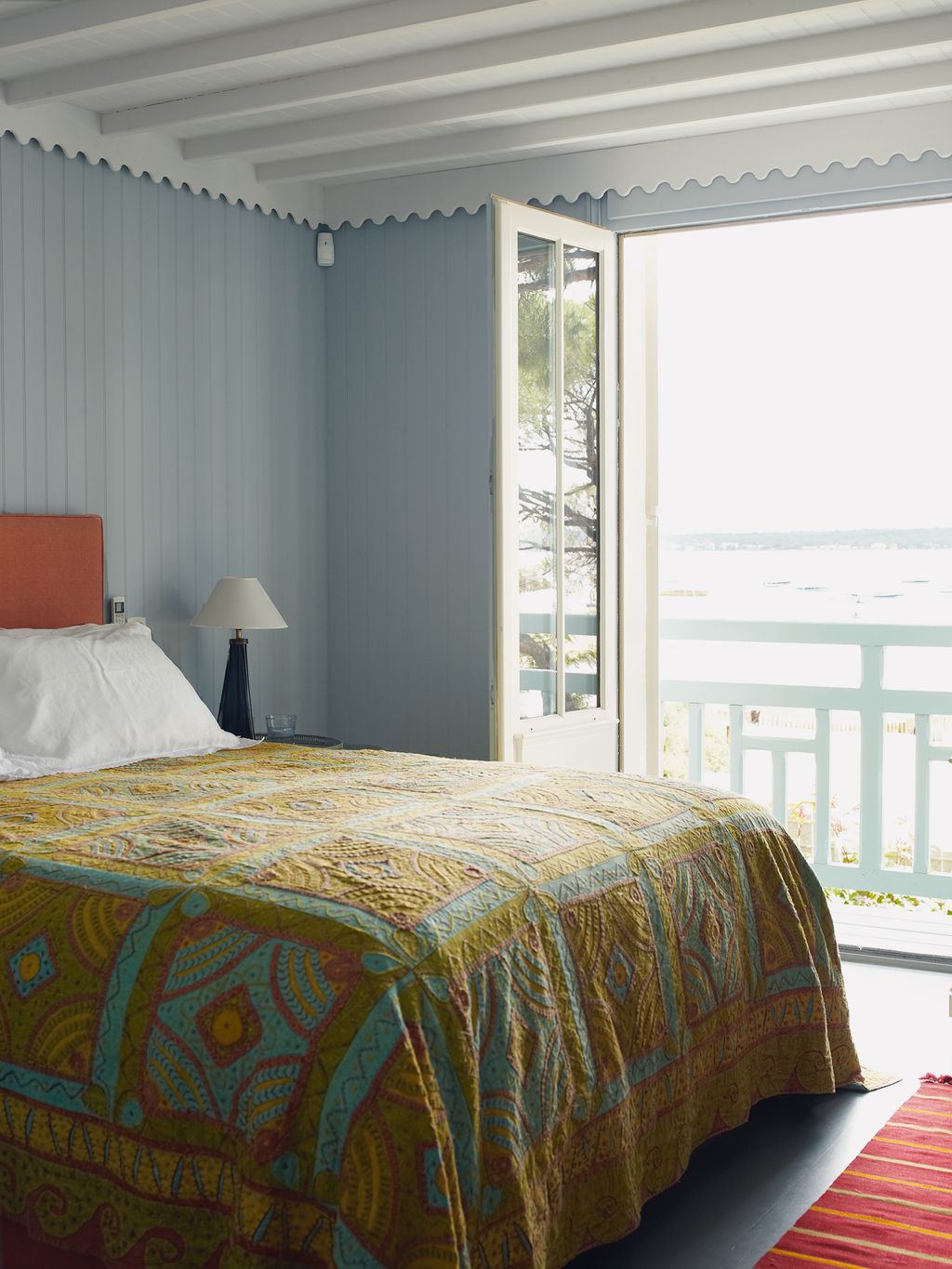
Upstairs in the main house, Guy created three bedrooms, each with a bathroom. Painted timber floors and walls trimmed with timber detailing set the tone, while zellige tiles in the bathrooms add bright blocks of colour. The rooms have a traditional yet upbeat feel and are furnished sparingly with things found on the owners travels and, in the lofty main bedroom, a majestic four-poster.
Downstairs presented more of a problem, and, even though they were well into the project, the owners called in London-based architect Jonathan Tuckey to help them find a solution. They knew they wanted a more open feel to the living spaces but could not devise a plan that would work. For Jonathan, the owners admit, it was not the easiest job. Much had already been decided or chosen, and, as Jonathan says, ‘Guy had a way in which he did things and we didn’t want to reinvent this. We didn’t want our design to look like a rocket that had arrived from west London.
‘Our feeling was that you should be able to see the whole space right through from one side of the house to the other – the house needed the drama of a big space.’ Now, you enter into a large hall-like area with views, via double doors, to the sea. ‘It is always difficult, when planning houses, for clients to accept rooms that are doing nothing, but generous nothingness is exactly what holidays are about,’ Jonathan says, and this luxury of space certainly has wow factor and a feeling of airy relaxation. A sofa, virtually the only piece of furniture, is dramatically strung from the ceiling on thick chandler’s rope - an idea of Jonathan’s, ‘to make it seem like a daybed that rocks in the breeze’. A sitting room leads off to the right, and a staircase to the left, both separated by a timber claire-voie screen – a striking device that cleverly maintains the transparency between the spaces while creating a sense of enclosure and allowing each 'room' to have its own identity.
Opening out beyond the staircase is a large, light kitchen and dining area. ‘The owners gave us a very clear sense of how their holidays worked and we knew there needed to be space for mountains of seafood to arrive and for everyone to join in preparing it,’ says Jonathan. So the long kitchen island has the quality of a seafood bar, as much as that of a kitchen work surface, enabling everyone to gather round. The original intention was that the island would be zinc, like the terrace awning Guy had designed, but it proved difficult to havemade, so stainless steel was used instead. For both the staircase and the island, Jonathan’s office made models that were sent out to Guy so that he could fully visualise what Jonathan was after.
The kitchen, handmade by Devon-based furniture maker James Verner, was designed to be robust and forgiving of holiday life and sandy feet. ‘Hinges are exposed and the drawers are oak boxes in an oak frame; there are no soft-closing drawers,’ Jonathan points out. It needed to age well, hence the rough bandsawn finish of both the kitchen units and the floor. It could not be simpler in many ways, yet it is totally bespoke; in the pantry, which opens off the kitchen, there are special sloping shelves designed to hold crates of fresh peaches from the market, and boxes lined with linen that can store up to ten loaves of bread. Jonathan has added light-hearted touches such as the clock hanging from the kitchen ceiling and the way the floorboards appear to climb up the wall, giving the impression of a tidemark.
MAY WE SUGGEST: A bamboo beach house designed by Veere Grenney
The Villa Isabelle that exists today is the fruit of a perhaps unlikely but remarkably successful collaboration between the owners, a local architect/builder and a London-based architect – each contributing their thoughtful and original ideas. The house has the appearance of having been designed, but in a low-key, utterly relaxed way. At Easter or the summer holidays it is a house that expands – the owners have three children and plenty of extended family and friends. Cars are abandoned in favour of bicycles and boats, and time is spent reading in hammocks, eating en masse at the long wooden table on the terrace, or enjoying a drink on the raised platform in the garden – designed by Guy - which allows views of the dunes as the sun goes down.
To rent Villa Isabelle, contact Private Properties Abroad: www.ppaproperties.com
Jonathan Tuckey Design: www.jonathantuckey.com
 Paul Massey1/13
Guy Allemand restored the exterior of the house and painted it in summery colours.
 Paul Massey2/13
The 4.3-metre-long table on the terrace was made by John Knuckey from a single length of oak; above it hang pendant lights from Retrouvius.
 Paul Massey3/13
The front door opens on to a spacious hall, with a sofa suspended from the ceiling on chandler's rope; above it hangs a pair of 'Victo 4250' pendant lights by Secto Design.
 Paul Massey4/13
Beyond the staircase is the kitchen and dining area, with a white stained, sandblasted-ash table handmade by John Knuckey of Knuckey Furniture. The kitchen was handmade by James Verner; the owners asked for open shelving on which to display pieces found on their travels.


 Paul Massey5/13
 Paul Massey6/13
Jonathan Tuckey installed timber claire-voie screens that subtly separate the hall from the stairs and the sitting room (below).
 Paul Massey7/13
The owners bought the sitting-room rug in Morocco.
 Paul Massey8/13
The main bedroom is dominated by an elegant four-poster bed from Guinevere.


 Paul Massey9/13
Vibrant green zellige tiles by Emery & Cie enliven a bathroom.
 Paul Massey10/13
Timber detailing and a colourful Indian bedcover add character to a spare room.
 Paul Massey11/13
A sliding door conceals shelves and hanging space, in front of which hang pretty metal lights from Emery & Cie.
 Paul Massey12/13
The raised terrace in the garden is positioned to afford views of the dunes, and furnished with wooden benches sourced by Guy from Indonesia.


 Paul Massey13/13
A boardwalk leads through the garden to the beach.


