
Why you should be growing the delicate, scented pelargonium

Pelargoniums are such a diverse family,’ enthuses Ursula Key-Davis. ‘If one group goes out of fashion, there’s always another that comes in. They are universally loved.’ Ursula has worked in the family business, Fibrex Nurseries, for more than 40 years, and has built up the extensive pelargonium collection that her mother, Hazel, started in 1958. ‘After she’d had six children, my mother decided that she needed to do something with her life. She had always been passionate about pelargoniums, so she rented a small nursery and started going to shows. I bunked off school to go and work on the stand at the RHS Chelsea Flower Show when I was 13, and later my mother persuaded me not to go off to college. She always said I could learn more with her – and she was right.’
The Warwickshire-based nursery is still the UK’s leading pelargonium specialist and has the largest collection in the world, with over 2,000 species and cultivars – as well as collections of ivy, ferns, begonias and hardy geraniums. Ursula works alongside three of her siblings as well as other members of the extended family. Heather, her sister-in-law, helps manage the pelargoniums.
Often mistakenly called geraniums, which are a completely different genus, pelargoniums (or pellies as they are affectionately known at Fibrex) are native to South Africa, where more than 250 species grow wild in habitats ranging from mountainside to seashore. Pelargoniums arrived in the UK in the 17th century and became popular as glasshouse plants, grown on large country estates. In Victorian times, they were used in elaborate bedding schemes in Britain’s parks and large gardens – these are now known as zonal pelargoniums and have rounded leaves and clusters of flowers in primary hues. The zonal plants are still much loved for pots and containers, as are the trailing ivy-leaved types but, as Ursula explains, the fashion over the past decade has been for the scented-leaved types and the dainty-flowered species pelargoniums.

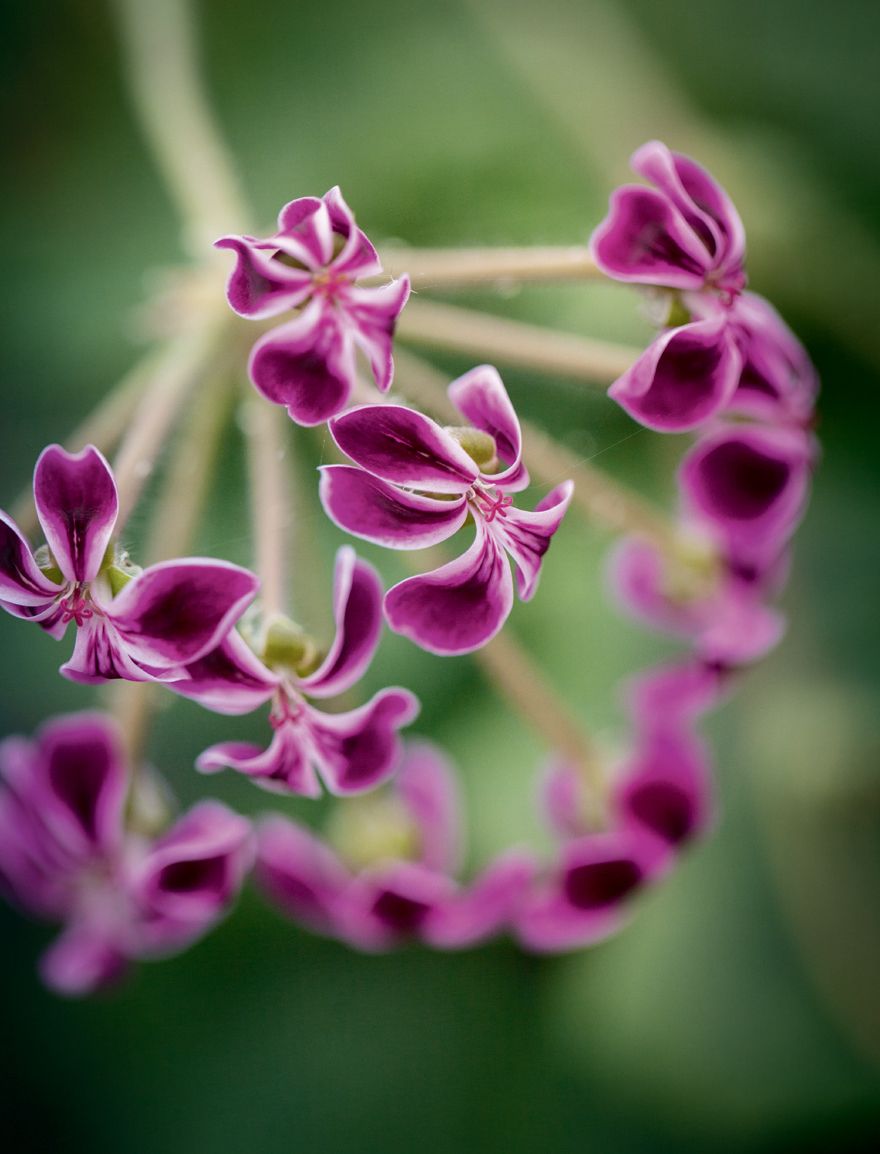
‘Some of the species and species hybrids are wonderful plants that produce masses of delicate blooms,’ she says. ‘But many of them are real collectors items that aren’t stock items in the nursery – we sell only a few of them each year.’ In colours ranging from darkest purple and maroon to palest creamy yellow, the flowers are like miniature butterflies – and the foliage, often scented, can vary hugely, from thick and succulent to fine and skeletal. Ursula’s particular favourites include P. trifidum, P. ‘Lawrenceanum’, with velvety purple petals, and P. ‘Ardens’, with its crimson and black f lowers. ‘Pelargonium trifidum is stunning,’ says Ursula. ‘It starts off as nothing and grows like a triffid. The blooms are creamy white. And ‘Lawrenceanum’ has night-scented flowers on arching sprays.’ Be aware, however, that this plant will have a period of dormancy in winter when it drops its leaves.
Among the scented-leaf pelargoniums, she recommends ‘Orsett’, which has pink flowers with darker markings and foliage with a ‘sharp, clean scent’, and ‘Grey Lady Plymouth’, which has silver-grey foliage and mauve-pink blooms. There are also some real curiosities in the collection. P. gibbosum has extraordinary yellow-green flowers, while P. appendiculatum has star-like apricot-tinged blooms. P. caffrum ‘Diana’ is a real oddity with fringed pink flowers. ‘My mother picked it out as a seedling and named it after her botanist friend, Diana Miller,’ says Ursula. ‘Like her, I am drawn to unusual things, so I keep all the weird and wonderful seedlings.’ It is this that makes the collection so interesting – as well as the fact that the nursery works with a team of amateur breeders. ‘They are typically men of a certain age, working in their own greenhouses and sending plant material in Jiffy bags,’ explains Ursula. ‘It means we can think outside the box – some commercial plants that have breeders’ rights are so boring.’
How to grow pelargoniums
Pelargoniums are tender perennials that need to be brought inside during the winter, so they are good candidates for growing in containers. Flowering from June until the first frosts, they can also be used as summer bedding plants. ‘Most pelargoniums are easy to grow, but you mustn’t over-water them,’ says Ursula. If growing them in pots, plant them into multipurpose compost and feed every few weeks with high-potash liquid feed, deadheading when needed. In September or October, bring into a cool, dry place and cut back by half. ‘At this stage, you can almost stop watering them,’ advises Ursula. ‘You may need to water once or twice over winter, but that’s it.’
The pelargonium collection is open to the public each year from May to September. Whether it is the scented-leaf types that entice you, or the delicate flowers of the species plants, or the classic zonal pelargoniums, you will come away with a new passion. And because they are easy to propagate from cuttings, your collection will soon be bursting out of your greenhouse or conservatory in a very satisfying way.
Fibrex Nurseries sells pelargoniums by mail-order from March to September, but due to unprecedented demand this year, they have run low on many varieties. For details, visit fibrex.co.uk.
 SABINA RÜBER1/9
Pelargonium ‘Orsett’ is a scented-leaved pelargonium with dark pink flowers.
 SABINA RÜBER2/9
P. gibbosum
 SABINA RÜBER3/9
Species hybrid P. caffrum ‘Diana’.
 SABINA RÜBER4/9
P. ‘Ardens’.


 SABINA RÜBER5/9
Scented-leaved P. ‘Dean’s Delight’.
 SABINA RÜBER6/9
P. appendiculatum has star-like blooms.
 SABINA RÜBER7/9
P. ‘Saxifragoides’.
 SABINA RÜBER8/9
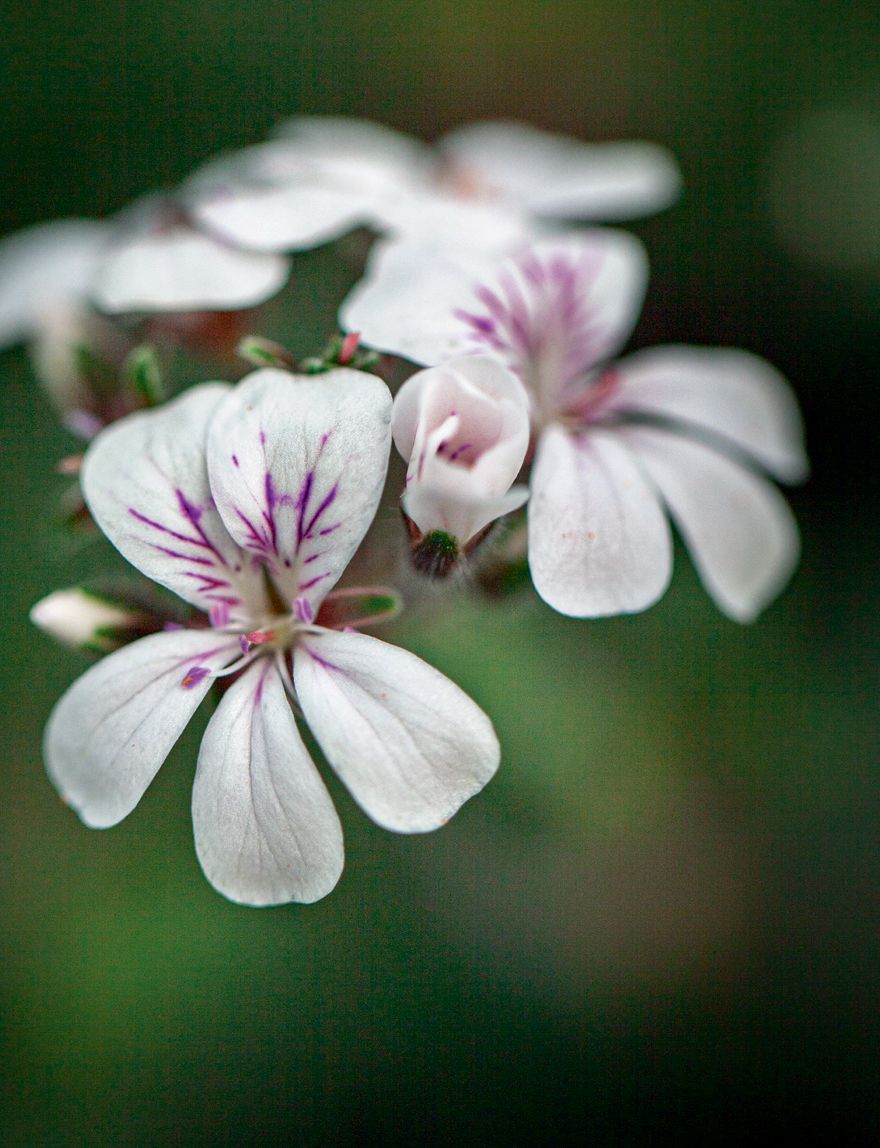
P. littorale


 SABINA RÜBER9/9
Ursula Key-Davis (right) and her sister-in-law Heather Godard-Key.


