
An unusual leaf-shaped house hidden away in the Cotswold countryside
'Yes. I remember Adlestrop.’ So begins Edward Thomas’s poem, recalling the tiny Gloucestershire village where his train unexpectedly stopped one day in June 1914. In its 16 short lines, he holds the whole world – one that is hurtling towards disaster – still, for a fleeting, golden moment. It is a poem about the essentiality of nature. It is also a poem about listening to our environment and preserving it, if we can.
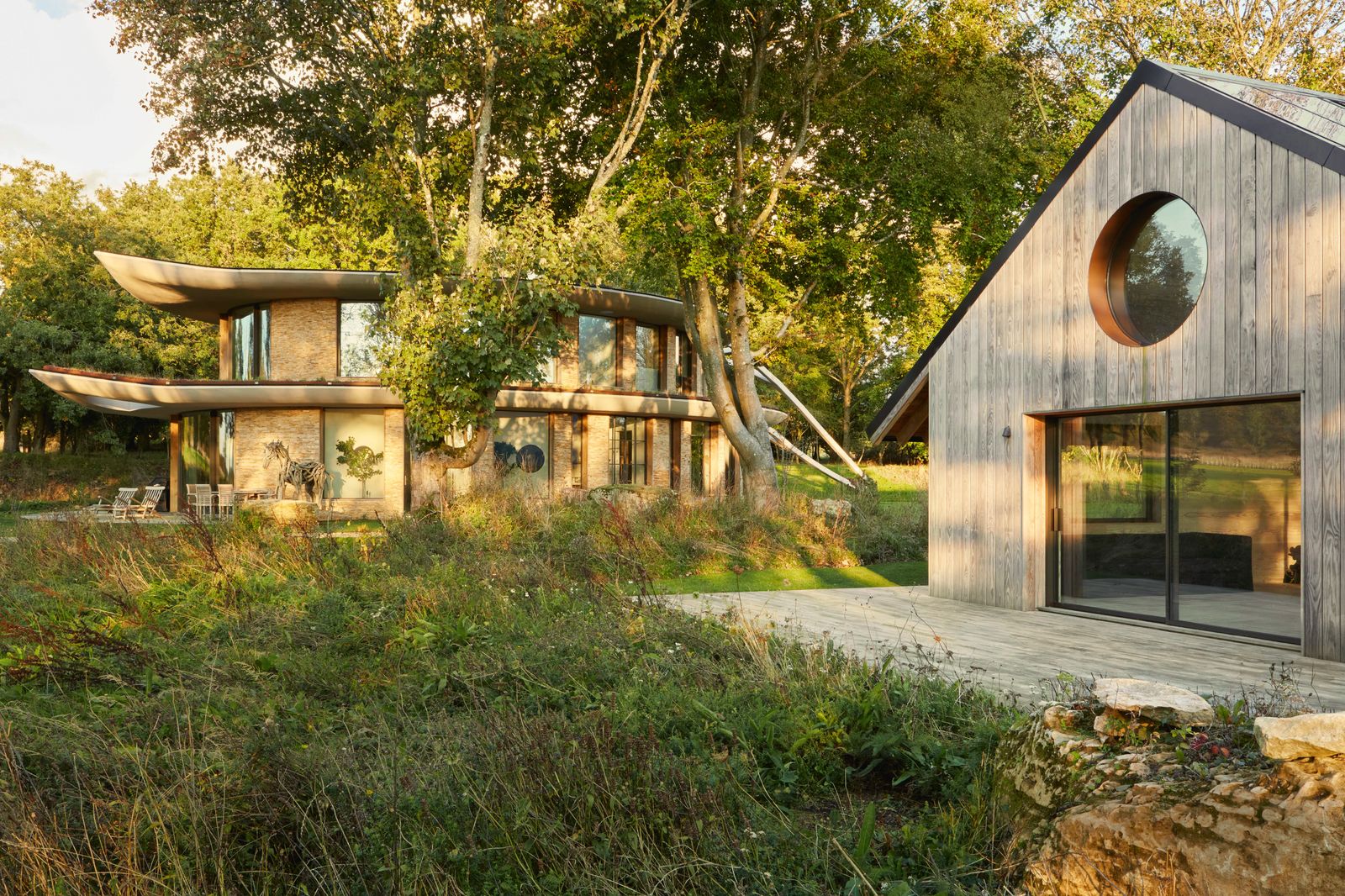
More than 100 years later and we are on the brink of a crisis of a different, climate-related sort – though nature, listening and preservation remain vital. One person who is aware of this is architect Alex Michaelis, one half of London- and New York-based practice Michaelis Boyd, and a resident of Adlestrop. It is here that he and his wife Susanna Parry Michaelis have recently completed Leaf House, a biophilic-inspired home that looks to, speaks with and mimics the world around it in extraordinary ways.


They were first drawn to the plot’s generously unfolding views. Two dilapidated farm buildings have since provided the footprint for two new structures. One is a 30-metre-long barn containing a home office, a yoga studio, two bedrooms with mezzanines that allow for additional sleeping areas for their children and grandchildren, a groundsman’s cottage, a workshop and a plant room that houses solar batteries and borehole water equipment.
The main house has been designed to look as though two leaves have gently drifted from a nearby tree, landing one on top of the other. They even have metal stems, which extend from each level, entwining at their tips and grounding the building both figuratively and literally. When I ask if they are structural elements, Alex responds with a laugh, ‘No – just mad and beautiful.’

Of course, it would not be an Alex Michaelis project without a little bit of madness (his west London base – dubbed ‘the house of fun’ – features a slide and fireman’s pole). And, naturally, the tale of Leaf House is somewhat unconventional, with Alex having spent more than a decade trying to get planning permission granted for the plot before he bought it. Was it just for the views? In answer, Alex leads me on a short walk to a hoard of buried treasure (at least, for an architect): a small disused quarry flanking what is now the driveway. Putting it back in operation, Alex used it to source every sliver of the honeyed Cotswold limestone that makes up the exterior walls of the main house.


That the house and land were in communion mattered to Alex. It is why there are so many windows in the two buildings, allowing you to connect with shivering greenery wherever you look. It is also why he installed living roofs on both levels of the main building. From the first storey, you gaze out across what could have been a terrace, but is instead a thatch of low planting, its green giving way to the green of the fields beyond, so the distinction is almost imperceptible. It is surprisingly powerful to feel as though you remain at the same level as the earth.

In the long barn, meanwhile, a connection to nature has been forged through Douglas fir boarding, with its marbled grain, inside and out. While the wood was not sourced locally (all the timber came from Dinesen), it feels entirely in sympathy with what Alex calls ‘the dingly dell’ – a sylvan glade surrounding the buildings.

The green roofs play a practical role, too, as their dense soil stops the rooms below from overheating in summer and insulates them when it is cold (the wall cavities are filled with lamb’s wool, the floors with plastic-free Ecoform). They are part of Alex’s wider consideration of performance here. Save for Wi-Fi, Leaf House runs completely off-grid. Water is UV-filtered and comes from a borehole on-site, while electricity is generated by solar panels integrated into the barn’s roof pitches, ingeniously flush rather than stuck on top. Any excess power is stored in batteries for rainy days and in good weather there is enough to sell back to the grid. Air-source heat pumps provide warmth for hot water and heating, and an underground Klargester tank at the bottom of the field uses microorganisms to break down waste, which then drains into a marshy planted area.


These high-tech solutions are impressive, but the most inspiring happens to be the most elementary. Around the perimeter of the ground floor, Alex has strategically placed voids between the main spaces and the outer shell of the building, using double walls to create a series of miniature greenhouses. As well as creating the perfect environments for a heady scented lemon tree on the southern side, for instance, or an unruly tree fern to the north, these transitional spaces help to control internal temperatures. In the summer, with all doors open, the rooms feel breezy. In winter, the greenhouses work like double glazing on an epic scale. It is a gratifyingly simple and elegant idea.

Throughout the house, the walls are finished in dappled, textured clay plasters handmade in Cornwall by Clayworks. Non-toxic and thermoregulatory, this ancient material is well suited to covering the building’s gentle curves – a Michaelis Boyd hallmark. ‘Why do we build corners when our bodies are not made with straight lines?’ asks Alex.
It is a good point. The rounded edges of Leaf House appear natural, sympathetic and inviting, almost nest-like – a feeling that Alex has underscored by the quiet incorporation of nature itself into the house. This is something he seems particularly excited by – in fact, he envisages a new world in which nature does not just inspire architecture, it is architecture: ‘Creepers that don’t just cover a structure, but support it, buildings that respond to the seasons.’ It sounds a little futuristic. ‘Of course it is,’ he says. ‘Architecture is ideas – it only really exists in the future.’ He is right, but I would argue it exists in memory, too. I know I shall remember Adlestrop
Eco credentials
To design a newbuild house that is off-grid and exists in harmony with its natural surroundings.
Alex Michaelis devised a biomorphic design based on the shape of leaves, built from limestone quarried on site and Dinesen timber from sustainable woodlands. Solar panels, air-source heat pumps and a borehole water treatment system provide electricity, heat and UV-filtered water.
An underground Klargester tank uses microorganisms to break down waste, which drains into a marshy planted area.
 James McDonald1/6
Black tiles from Mosaicomicro, a ‘Marsiglia’ basin by Agape, a ‘Catino’ box mirror by Cielo and Flos wall lights create a sleek look in the children's bathroom.
 James McDonald2/6
The barn houses an office and yoga studio on the ground floor. In the office space, a ‘Tulip’ table by Eero Saarinen for Knoll with Ikea chairs provides a collaborative workspace in the long barn.
 James McDonald3/6
The pale Douglas fir cladding from Dinesen and picture windows on three sides create a serene feel and a sense of connection with the surrounding landscape in the yoga room.
 James McDonald4/6
The spare room features a a low table by Goldfinger bears an Original BTC lamp beside the bed, which has a Secret Linen blanket that tones with curtains in de Le Cuona linen. The mezzanine level above accommodates another double bed used by visiting children and grandchildren


 James McDonald5/6
A view of the ‘stalks’ at the back of the leaf shape.
 James McDonald6/6
The stone for the walls of the house was quarried from this dell that leads up to the house.


