
A rare and remote 18th-century Carmarthenshire cottage restored to its authentic form

Nestled deep in the hills of rural Carmarthenshire, under skies unsullied by light pollution and buffered from the ingress of global news in its WIFI-free location, this diminutive Welsh cottage is an atmospheric example of the homesteads hand-built by rural farm workers in the 18th century. Created from hand-hewn branches and scavenged coarse rubble, few properties exist in such an authentic form and those that remain are mostly in terminal decay. A family home until 1965 when it was abandoned, along with most of its original furnishings, the dwelling stood unoccupied and therefore preserved from unsympathetic restoration for almost 40 years until current owner Dorian Bowen discovered it and sensitively brought it back to life. The former chartered surveyor was looking to move from London back to the locality of his birth, seeking reconnection and a slower pace of life. In many ways the cottage's remote location, rudimentary structure and lack of modern essentials, including electricity and plumbing, were its saving grace.
‘I grew up on a farm in the area and every time I came back to visit family over the course of my 20-year-career in London I would see that a few more bolt holes from my childhood had vanished. I was aware of a rapid decline in vernacular architecture as original farmstead cottages across Wales disappeared,’ Dorian explains. ‘This property was almost derelict when I acquired it in 2004 but strangely that was what made it a bit of gem. In this very rural community, properties were often retained by the owners well into their 80s and 90s. When they passed away and the houses went onto the market, original interiors were commonly ripped out because many new owners felt that a parlour and other such features of the original layout didn’t lend themselves easily to modern life.’

Dorian’s approach was entirely different. He wanted to safeguard and restore a time-capsule of a farmstead. It was the most serendipitous match. ‘Having been abandoned for four decades the cottage suffered from many rotten joists – especially on the ground floor - but all were original and even the bressumer beam above the inglenook fireplace was still in place. On my first visit I was astonished to discover that all of the original furniture and the kitchen utensils had been left behind – even the knives and forks – and that evoked such a nostalgic feeling; it really spoke to me,’ he says. ‘After I bought the cottage, I went on to discover old photographs and I was able to meet some of the former inhabitants – a family of five – which further solidified my sense of connection.’
Dorian gently and lovingly resuscitated the two-up-two-down property; conserving its original features and calling upon memories of the houses of his childhood to reintroduce authentic details. He converted the former cowshed into the current kitchen, adding a Rayburn stove for cooking and warmth, and turned the dilapidated dairy into a rustic bathroom. Bar these two concessions to modernity the rest of the house is largely unchanged. Painstaking redecoration involved the time-consuming but pleasurable process of sourcing period-specific fittings from auctions, eBay and antique shops.

To stick-back furniture, a sturdy dresser, a pig bench and a traditional Welsh box bed, Dorian has added antique Welsh textiles and handmade objects. Everything set against the simplicity of traditional lime-washed walls.
‘I’ve owned the cottage now for more than 20 years and over that time I’ve slowly collected authentic pieces to give the interiors greater depth and, I suppose, to express myself, too. When you go around antique shops today it’s very rare to find these sort of pieces: primitive chairs and treen (small handmade functional household objects made of wood) are much more collectable now. I wish I had bought even more 10 years ago,’ he says. ‘I’ve been able to ask my mother how she would have used certain pieces and to position them in the cottage in an historically accurate way. My intention has been to recreate the interiors so that if someone from 100 years ago walked over the threshold, they would immediately recognise the setting and feel at home.’

Named Bryn Eglur – which means Clear Hill in Welsh – the cottage is a living, fascinating testimony to Dorian’s determination to honour his forebears and capture the feeling of walking back in time. ‘What started out as a journey to reconnect with my roots has become so much more,’ says Dorian. ‘It has become a lifetime project and one I love to share.’
Bryn Eglur is available as a holiday let via www.thewelshhouse.co.uk
 Brent Darby1/18
The former adjoining cowshed was incorporated into the two-up, two-down cottage to create the kitchen. Metal utensils sit on the slab bench which Dorian made.
 Brent Darby2/18
The former pig sty is now a small utility room and outside toilet. It features the original front door which Dorian relocated here. He replace the front door with a sturdier oak design. New cast iron guttering was installed.
 Brent Darby3/18
 Brent Darby4/18
This corner of the living room is separated from the entrance hall by a partition of interwoven timber panelling. Dorian rebuilt the oak seating complete with end scroll as a reproduction of a piece held by St Fagan’s Museum. The square Victorian table features a collection of Treen. The chair on the left is an original spindle back Windsor.


 Brent Darby5/18
Dorian sourced this 17th century Court cupboard from London although it is authentic to the Welsh Borders. ‘It is possibly a bit grand for this cottage’ but it makes a wonderful storage and a lovely companion to the oak settle. Staffordshire dogs and a Slate mantle clock sit on top.
 Brent Darby6/18
View into the parlour from the hallway. The original paintwork on the stairway panelling probably dates to the Victorian era. Dorian fitted the slate mantle to the parlour. Above it hangs a print of a landscape and cottage by Kyffin Williams, an artist from North Wales.
 Brent Darby7/18
The Welsh Slate miniature model bureau – or chest of drawers – is an authentic example of 19th century folk art from North Wales where the landscape geology is rich with slate. Such pieces were carved by quarry men and might be entered into competitions in events such an Eisteddfod festivals, given as wedding gifts. Alongside sit more Staffordshire figures, a hardwood tea caddy and one of the original photographs that Dorian salvaged from the abandoned cottage.
 Brent Darby8/18
A vignette of a collection of wooden reels and earthenware pots alongside contemporary pots on a slate chimney.


 Brent Darby9/18
Dorian made this looped spoon rack in hazel as a copy of one featured at St Fagans – the National Museum of History near Cardiff. It is hung with sycamore Caul spoons.
 Brent Darby10/18
Situated in the parlour, this South Wales pot board dresser was sourced from Carmarthen market. Its scale perfectly fits the low head height of the room which measures two metres from floor to ceiling. Dorian has dressed the piece with pewter plates, metals jugs, original utensils, stoneware confit and earthenware pots. To the left sits a carved wooden dough trough and a butter churn.
 Brent Darby11/18
A fascinating array of antique utility pieces include a Butchers block, a primitive stool, a selection of large earthenware bread-proving bowls and an enamel flour bin.. The ‘Salem print’ – which once featured in a Victorian calendar was commonly cut and framed by many homeowners and thus was a popular traditional image with religious resonance that appeared in many similar Welsh cottages.
 Brent Darby12/18
The scrubbed Sycamore kitchen table is surrounded by oak chairs. Dorian explains that Sycamore is a wonderful wood for scrubbing clean because of its close grain. It is also a wood that doesn’t tarnish the flavour of bread being kneaded on its surface. The window and door recesses reveal the thickness of the Tydden walls, hand built from scavenged local stone. They are about 2ft deep and in reality are constructed of two walls with a cavity between which traditionally filled with soil.


 Brent Darby13/18
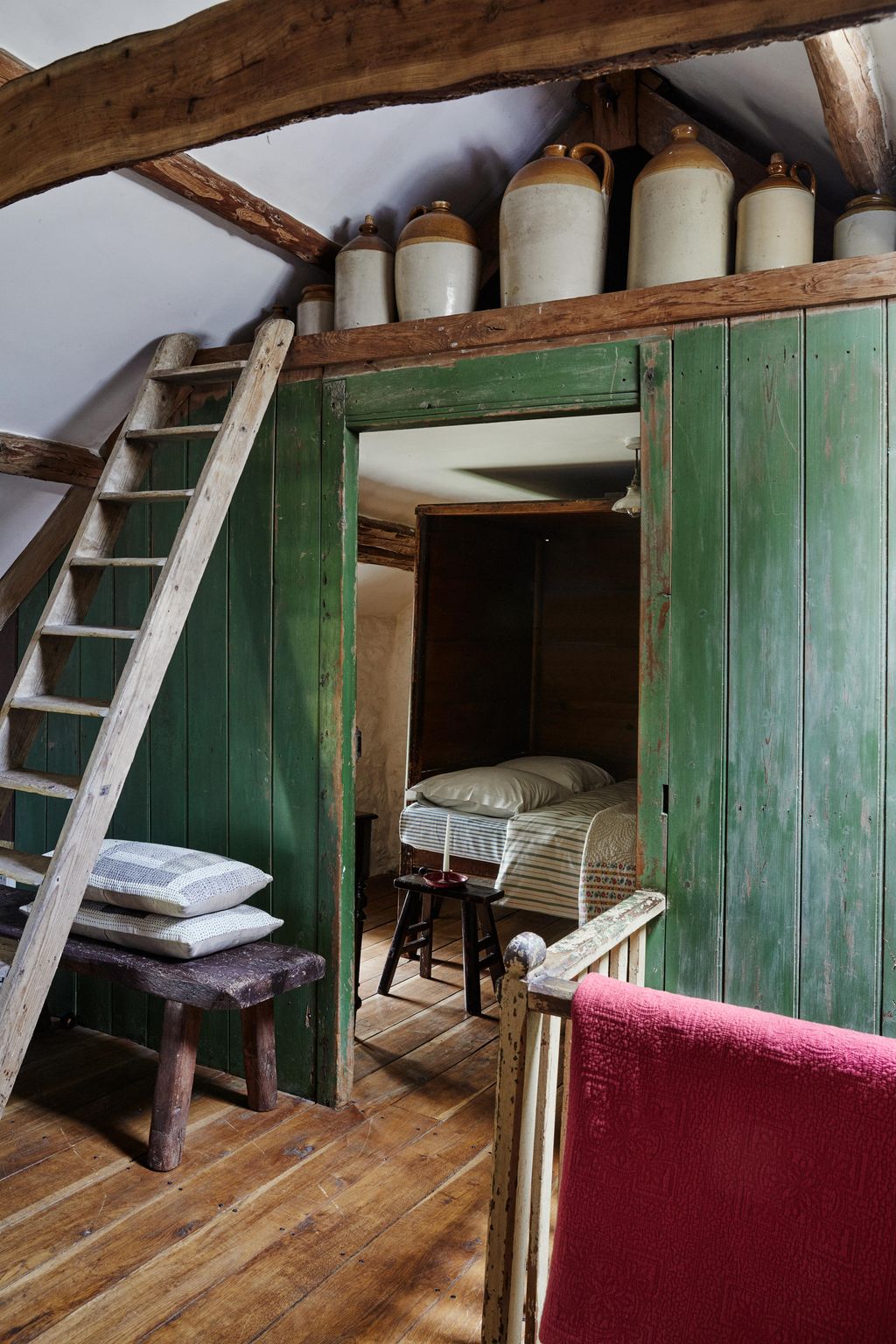
Upstairs the main bedroom opens into the interlocking second bedroom.. The Victorian partitioning features original green paintwork. The ladder is an original from the cottage, used for decorative effect. The Pig bench features Kantha stitched cushions on top, a welsh quilt hangs on the original painted handrail. The flooring is reclaimed oak.
 Brent Darby14/18
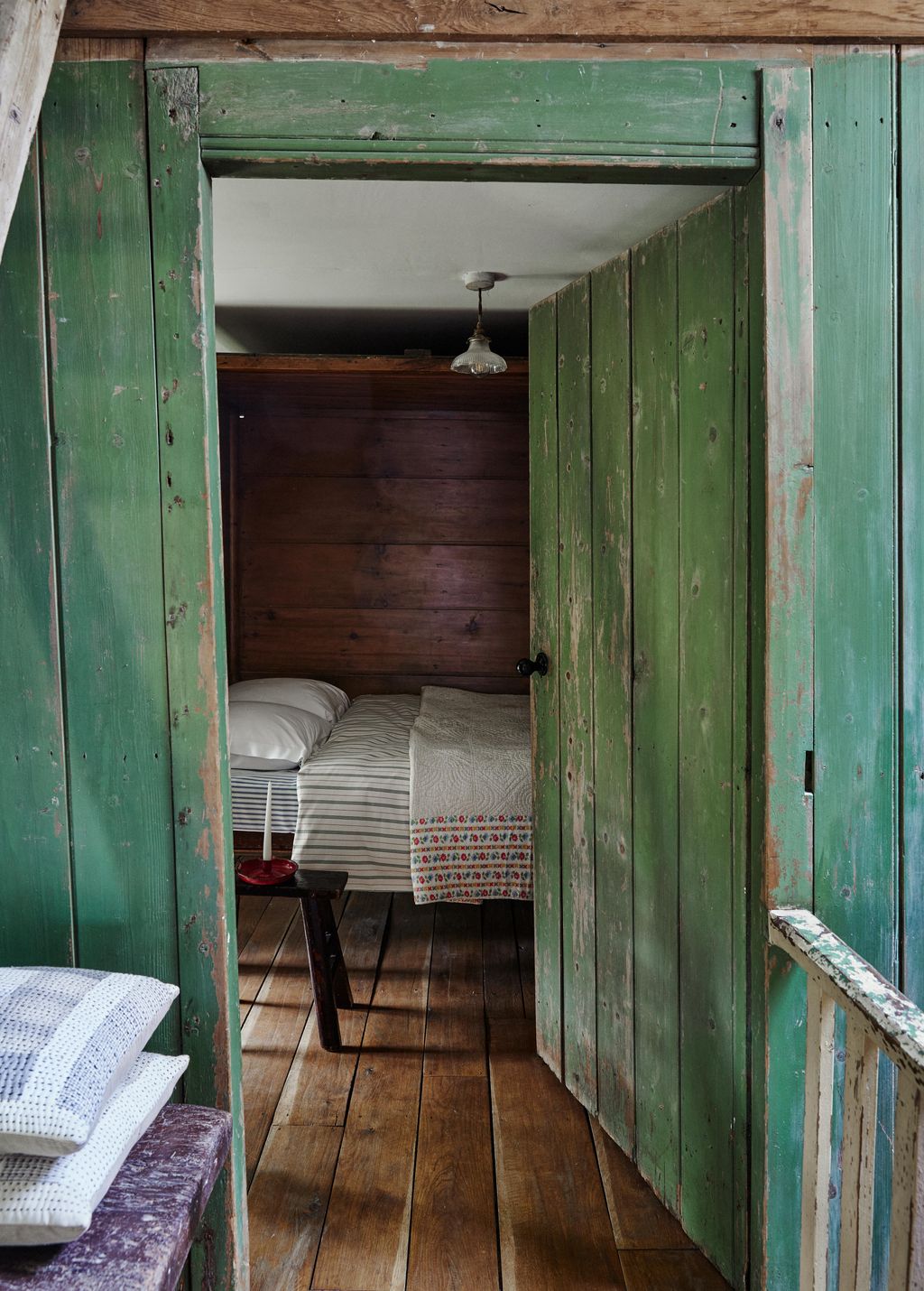
The second bedroom features a traditional Welsh box bed dressed with ticking and a welsh quilt. Dorian subtly Introduced electricity to the cottage, hence the discreet addition of the pendant light to complement the enamel candle holder.
 Brent Darby15/18
The narrow loom quilt belonged to Dorian’s great, great grandparents: narrow loom because it was woven on a loom about the width of a kitchen table and thus the finished piece is actually formed from two woven halves stitched together in the middle. Dorian found the cast iron bedstead in an antique emporium in London. The Chimney hood sits alongside exposed A-frame trusses. An antique blanket chest is flanked by two oak chairs.
 Brent Darby16/18


 Brent Darby17/18
The bathroom which was installed within the old dairy on the ground floor features a cast iron bath and – as all plumbing - is fed with a water supply from the cottage’s own borehole
 Brent Darby18/18
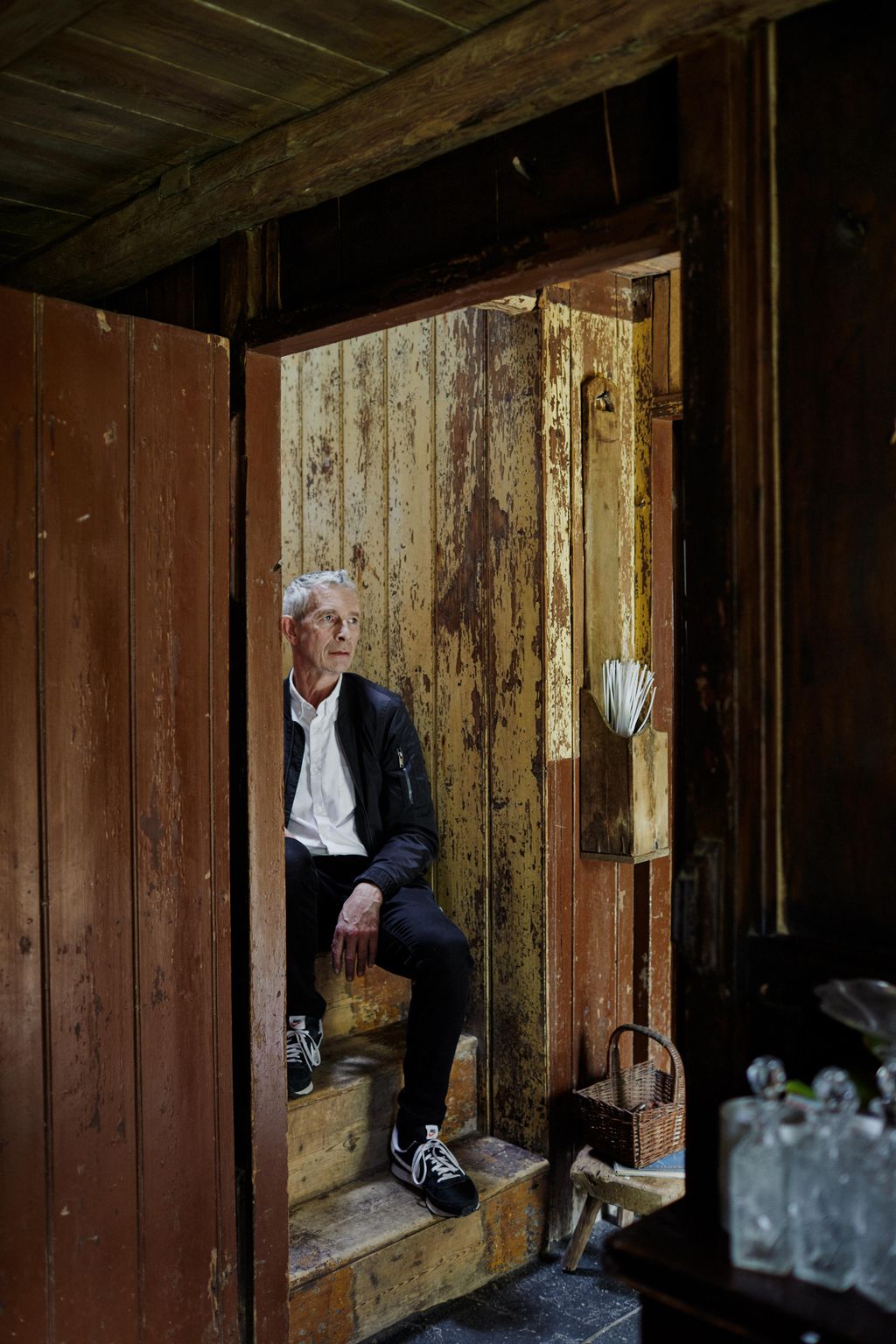
Dorian Bowen


