
A historic London house reinvented for the descendants of the man who built it

Renovating any period house can be daunting, but in the case of Tristan and Jemma Phillimore, a 300-year-old family connection to the area raised the stakes considerably. Part of west London’s historic Phillimore Estate, constructed by Tristan’s ancestor William Phillimore in the early 19th century, the townhouse had been rented out for the best part of two centuries. Then, two years ago, with the house finally untenanted, there was an opportunity for the couple to update it to create a home suitable for them and their young children, then aged seven, three and one.
‘Turning it into a family house was all about injecting it with our personality, while understanding that we are simply custodians of the beautiful old buildings on what was originally a 90-acre estate,’ says Jemma. ‘It was important not to take the house apart, but to recognise its heritage. I’ve seen many houses on our street transformed into unrecognisable spaces. That was not the direction we wanted to go in.’
With Spratley & Partners – the architects behind one of Jemma’s favourite hotels, Heckfield Place – on board, the bones of the house, which was built in about 1862, were gently rearranged in 2020. On the first floor, two bedrooms and two bathrooms were turned into a main bedroom with an en-suite bathroom and a compact home office – which would become a pandemic essential – elevated by bespoke joinery. Another floor was turned over to the children’s three bedrooms and a bathroom. ‘It’s like a mini apartment, which they love,’ says Jemma. The couple debated whether to move the lower-groundfloor kitchen, but with the ground floor offering obvious potential for creating adjoining sitting and dining rooms, it made sense to respect the building’s original layout.
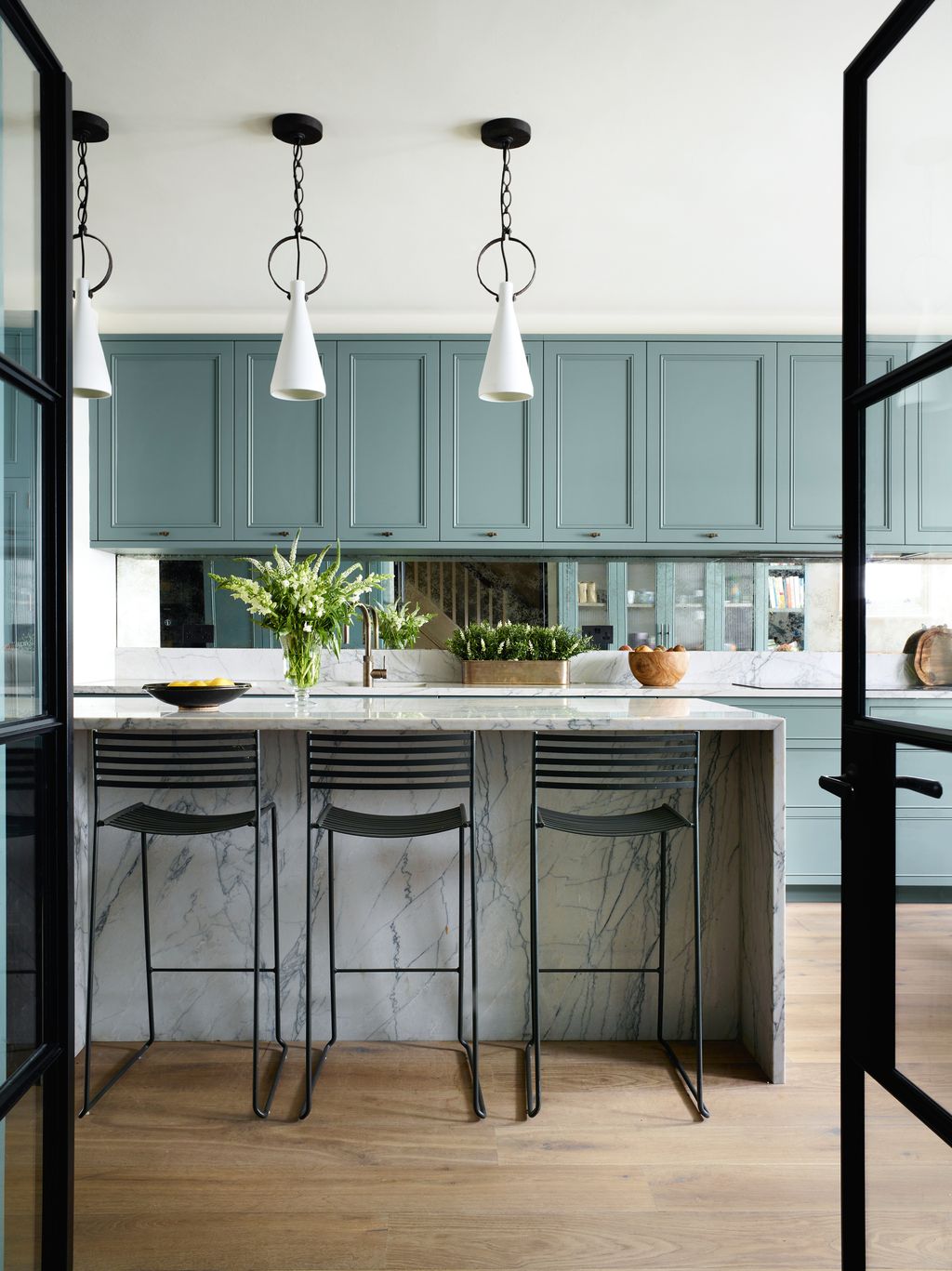
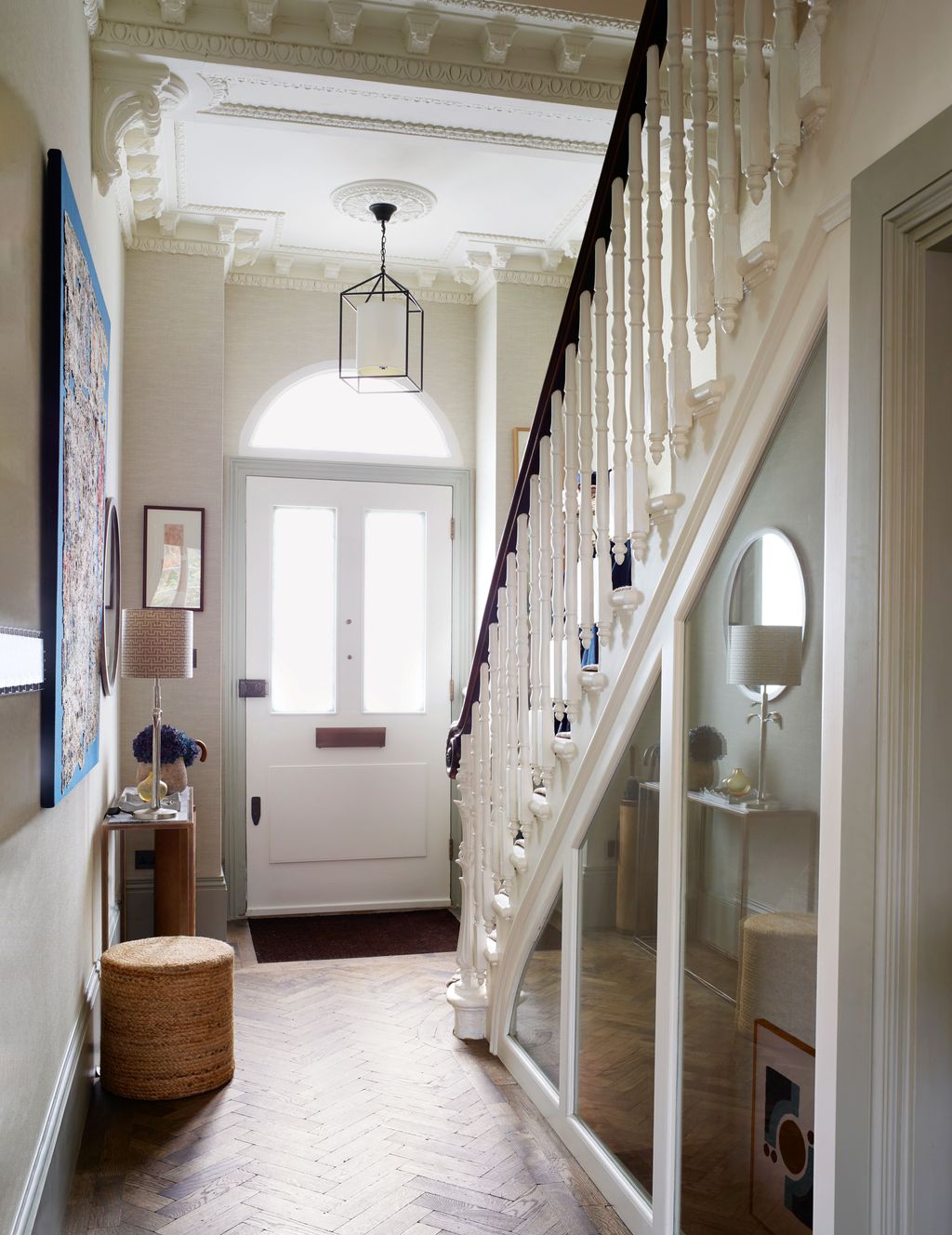
A lack of natural light on this lowest level was solved by inserting glass panels below the staircase, combined with generous Crittall doors opening out to the kitchen, a detail echoed in the snug beyond. ‘These tweaks created a much better flow in and out of the kitchen while doing very little structurally,’ says Jemma. ‘I focused my attention on the finishes. I felt I wanted to introduce energy with colour and interesting patterns.’
That ambition was realised with the help of interior designer Alice Leigh, who had worked on the couple’s previous London house. A shared love of pattern, notably wallpapers, has resulted in unexpected details throughout. These include Beata Heuman’s ‘Marbleized’ wallpaper in the cloakroom on the lower-ground floor, with its peacock feather effect, and the Perspex-framed vintage rug that is displayed on the wall of the sitting room.
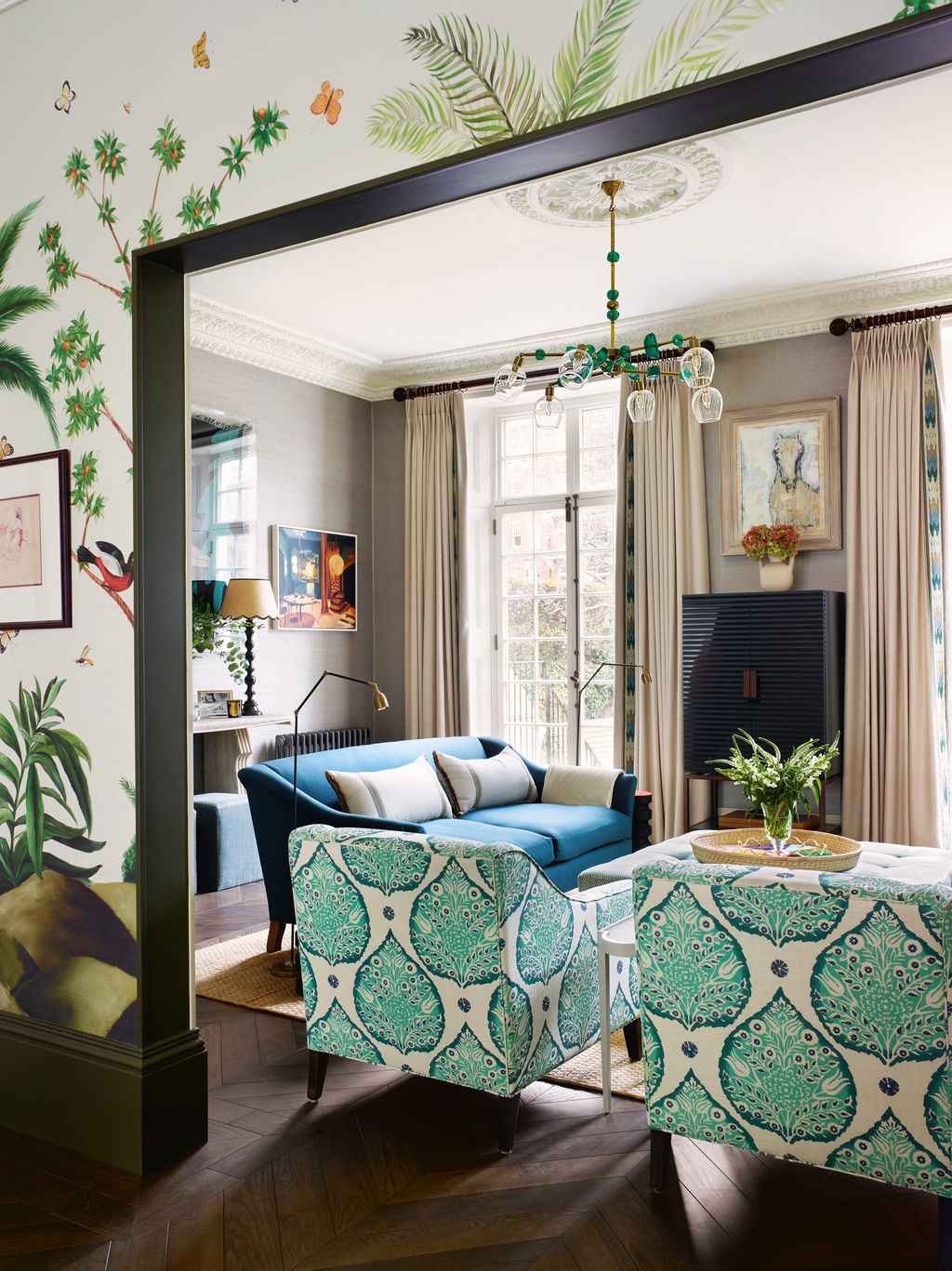
Two armchairs from the couple’s previous house, recovered in Galbraith & Paul’s ‘Lotus’ linen became the linchpin of the newly conjoined sitting and dining rooms on the ground floor. ‘We wanted to riff on that print and its palette, so they were integrated into the scheme,’ says Alice. ‘As a result, the chairs effectively unite the two spaces while also creating a natural delineation.’
However, it is the Pierre Frey wallcovering on all four walls of the dining room that captivates the eye. Palmladen, flamingo-studded and laced with butterflies and wildlife, it lends the scheme a surprising touch of exotica that blends effortlessly with rich herringbone flooring and dark wood door frames. ‘I saw it used as a backdrop to a fashion shoot in a magazine and fell for it,’ says Jemma. ‘The dining room isn’t used every day, but I walk past it all the time so I knew it was the place to be adventurous.’ Hanging it was a challenge – especially figuring out which panels would surround the chimneypiece. ‘The results are worth it. I’m never bored, because it changes throughout the day – zingy and vibrant in the daylight and softly elegant in the evenings.’
It is a surprising departure for a couple whose previous house was mostly characterised by grey and monochromatic elements. ‘Before, I definitely found comfort in what I perceived to be safe,’ says Jemma. ‘So I wanted Alice to help me to be brave in this house. I felt it needed lots of pattern and colour, but the elegance and history of the space also demanded serene pause points.’ In places, schemes are pared back – the better to let the details sing: a mirror encircled by a red frame; a chimneypiece surrounded by antique mirror glass; a plain sitting-room curtain with a graphic coloured trim. ‘Whimsical, playful and fresh, yet never precious, is how I would describe this house,’ says Alice. ‘During the pandemic, the family turned the dining room into a jungle gym for the children, so the vinyl mural on the walls came into its own.’
A love of mid-century Danish design also pervades, from the Hans J Wegner ‘Wishbone’ chairs round the kitchen table, to a Tom Faulkner contemporary leather armchair that nods to this look in the sitting room. ‘We’ve mixed antiques and family heirlooms with modern pieces by small independent designers and timeless, bespoke objects that we knew would be with us for ever,’ says Jemma. One cannot help but feel that the house’s first occupant, the prolific 19th-century London builder Jeremiah Little, would have approved of this future-proof philosophy.
 Rachael Smith1/9
Around the original chimneypiece, antiqued mirror panelling from Mirror Works brings light and depth to the scheme. An ‘Emerald’ chandelier by Margit Wittig, a bespoke ottoman covered in a Turnell & Gigon fabric and a ‘Berlin’ leather chair by Tom Faulkner are set off by ABA Interiors ‘Sequin NS 8013’ wallpaper from Altfield.
 Rachael Smith2/9
Favourite armchairs, in Galbraith & Paul’s ‘Lotus’ linen in emerald, are balanced by a Lorfords ‘Elmstead’ sofa. A painting by Philippe Bonnet is displayed above Julian Chichester’s ‘Bunny’s Bar’ in ‘Studio Green’ by Farrow & Ball.
 Rachael Smith3/9
Reid & Wright’s ‘Ridge’ mirror, in ‘Atomic Red’ by Little Greene Paint & Paper, complements the eye-catching Pierre Frey ‘Canaima’ wallcovering. Vaughan’s ‘Colombier’ chandelier hangs above a Galvin Brothers dining table teamed with chairs from Andrew Martin.
 Rachael Smith4/9
Guy Goodfellow Collection’s ‘Fez’ wallpaper in sea foam is the backdrop for a ‘Brakka’ wool rug from A Rum Fellow and a Tom Faulkner ottoman. In the corner, Gabby Deeming’s ‘Editors’ chair for David Seyfried is partnered by a ‘Cocher Drinker’s’ side table from Galvin Brothers.


 Rachael Smith5/9
Designed by Chantel Elshout, the kitchen has cabinetry in Little Greene Paint & Paper’s ‘Livid’. ‘Limoges’ pendants from Circa Lighting hang over the marble-clad island, with ‘Aero’ steel bar stools from Emu.
 Rachael Smith6/9
The original staircase was refurbished and glass panels inserted to bring light into the basement.
 Rachael Smith7/9
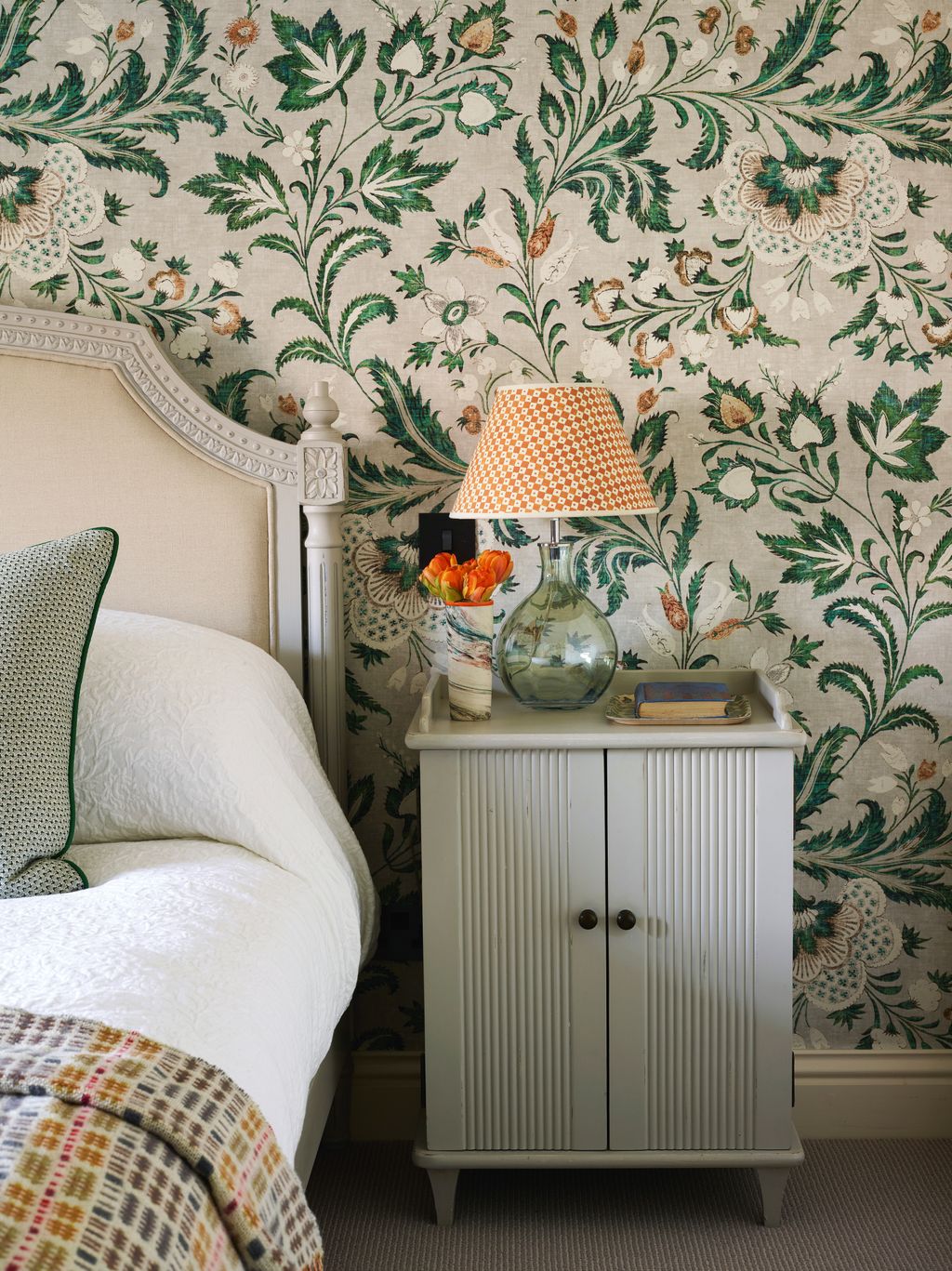
A headboard in de Le Cuona’s dusk ‘Malmo’ linen tones with ‘Adam’s Eden’ wallpaper by Lewis & Wood.
 Rachael Smith8/9
A Rosi de Ruig lampshade and wool throw from FelinFach pick up on Lewis & Wood’s ‘Coromandel’ wallpaper in malachite.


 Rachael Smith9/9
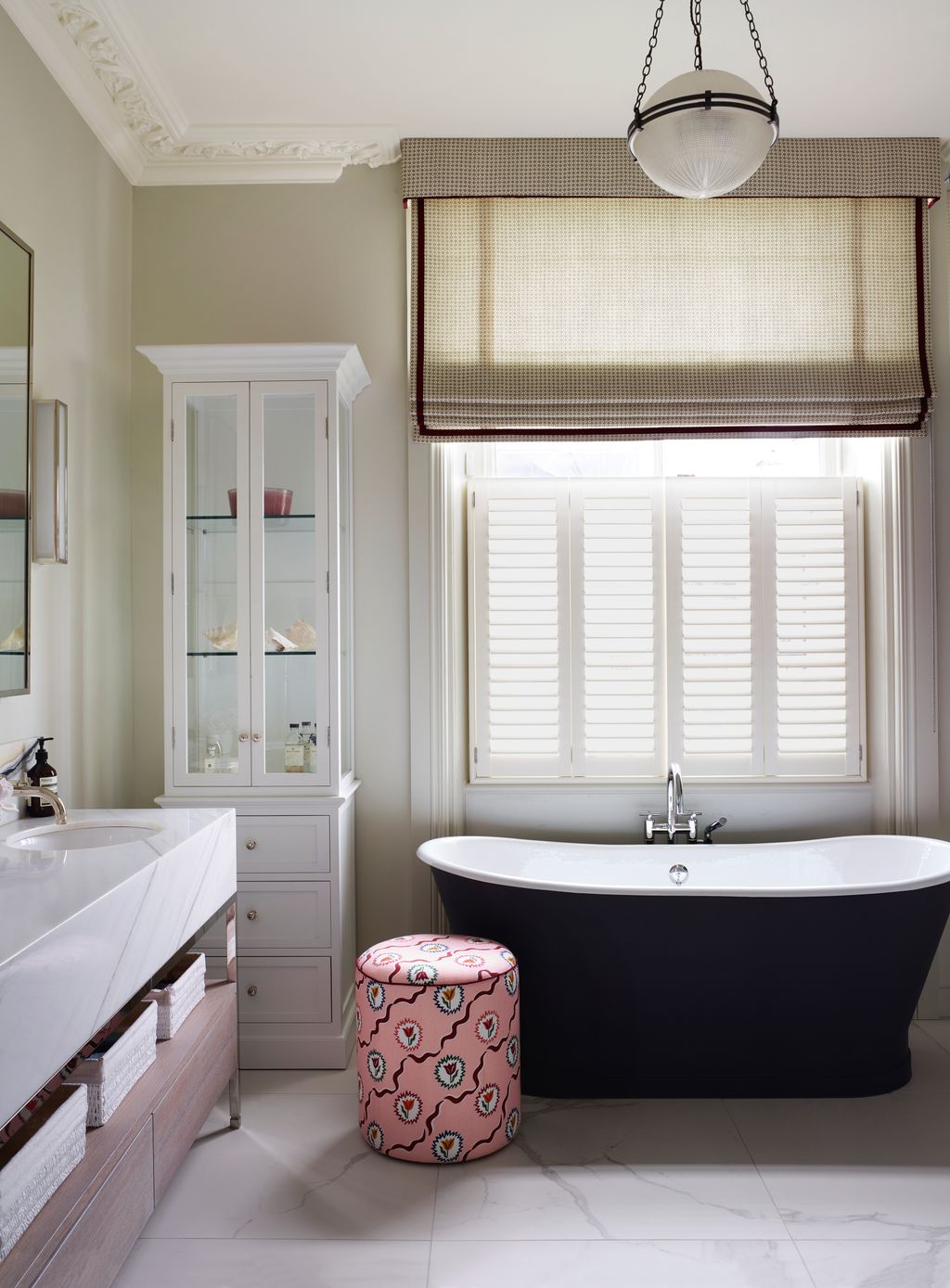
The CP Hart bath is paired with a vanity, taps and mirrors from Porter Bathroom and a Hector Finch ‘Globe Prism’ light.


