

Westward to Wales and the small town of Cardigan – aka Aberteifi to those who might prefer to use its Welsh name. Hard though it is to imagine now, this was once one of Britain’s most significant trading ports, rivalling even the likes of Bristol and Liverpool, and lending its name, rather grandly, to almost the entire western seaboard of Wales – Cardigan Bay.
Surprisingly, however, Cardigan isn’t even on the sea but a mile or so inland on the banks of the River Teifi, up which, with precision steering and careful attention to the tides, shallow-draft ships were able to navigate as far as the town’s medieval bridge. In came wine, coal, timber, lime, oil and tobacco and out went tin, wool, leather, slate, grain and a fair few locals, fancying their chances at a better life in Canada.
With the boom in trade came ship-building yards and, most interestingly for this story at least, riverside warehouses – two in particular which have stood the test of time as bastions of Cardigan’s maritime heritage. Standing handsomely on the southern bank of the river, right by the bridge, the warehouses have undergone a recent metamorphosis: the left hand one opening as a hotel; the right hand one still transitioning to include a new restaurant (launching in spring 2023) beneath a handful of holiday apartments.
.jpg)
At the helm of this project are the dynamic husband-and-wife team James Lynch and Sian Tucker who, some might say, have been the driving force behind Cardigan’s recent renaissance as a hub of art, craft, food, design (and, of course, tourism), the like of which is unknown on the Welsh coast.
The Albion hotel, named after the ship which took numerous emigres to the New World, is the latest addition to James and Sian’s Fforest empire, a holiday concept which began with the acquisition of nearby 200-acre Fforest farm and the development of wide-ranging accommodations - farmhouses, lofts, geodesic domes, tepees and cabins – for guests wanting to get stuck into nature. ‘Over the years we have slowly been creating a place where living, playing, inspiration, adventure learning can happen in the beauty of the great outdoors,’ says Sian of the concept that has expanded to a further site on the coast at nearby Manorafon. And now there’s the hotel, too.
.jpg)
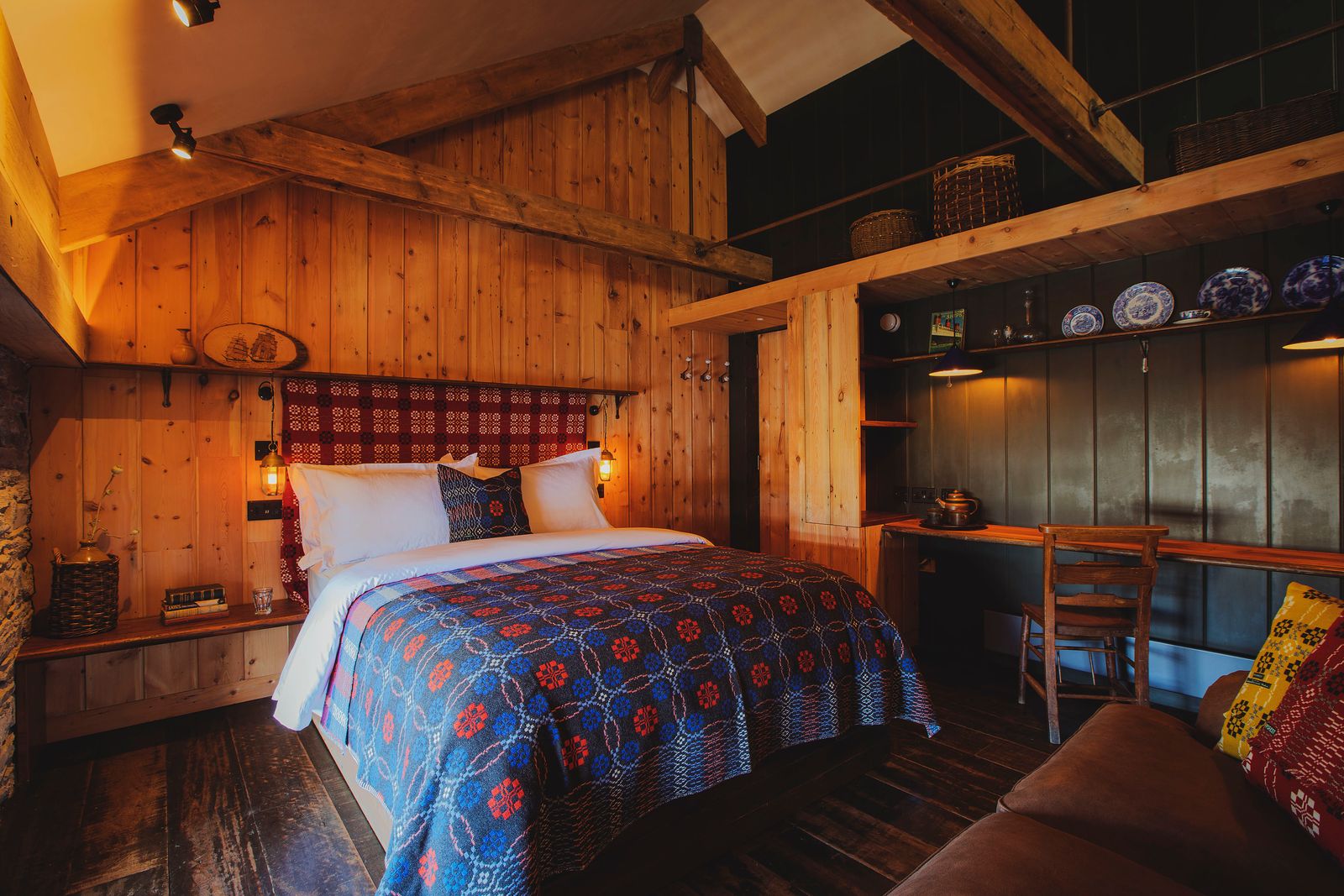
The Albion is as robust on the inside as it is on the out – unashamedly embracing its industrial warehouse roots in the use of steel, lime wash, stone and, most notably, wood. Reclaimed timber abounds, on walls, on floors, in furniture, in fixtures and fittings creating a vibe that feels part Scandinavian, part Alpine – even a little bit Japanese. It is a masterclass in upcycling with church pews refashioned into shelves, benches and desks, old schoolroom cabinets into cupboards and storage units. Ceilings are low, spaces are tight (ship-shape and cabin-like one might say) and colours are dark and moody, save for the odd burst of red or yellow in the exquisite, locally woven woollen headboards, cushions and blankets.
.jpg)
There are twelve rooms in total, four per floor, each named after a passenger (and their associated trade – tailor, carpenter, farmer, blacksmith et al) who departed on the good ship Albion in 1819. Rooms at the top are the pick, with higher ceilings reaching to the eaves and more elevated views through low-slung windows of the roiling river outside. Particularly tall guests on the lower floors might need to stoop a little.
At present, The Albion serves only breakfast and drinks (don’t miss the cocktails which are based almost entirely on locally produced gin, vodka, whisky and vermouth) but coming soon in the next-door warehouse is Yr Odwyn, which will specialise in Fforest’s signature wood-fired cooking with many of the ingredients sourced directly from the Farm.
In the meantime, guests can amble across the bridge to the town itself where there are plenty of alternative eating options, most notably Pizzatipi, another James and Sian venture this time in a former boatyard which has been converted to incorporate a small pub, a large tepee, a wood-fired oven (of course) and lots of seating, indoors and out, for riverside revelry.
The summertime Cardigan scene, I imagine, is considerably different to autumn when I visit. Kayaks and paddleboards have been packed away for the season, boat trips and other adventure activities have shut up shop, but Wales – in my book, at least – is as good out of season as ever. I potter round Cardigan, pulling together a picnic of sorts - local cheese from the castle delicatessen and bread from Crwst, the town’s famous bakery - and head to the coast. Poppit Sands, Mwnt and Penbryn Beach – all names to conjure with as a wild wind begins to blow and the rain comes searing in.
The Albion, Cardigan, Ceredigion (01239 615513; albionaberteifi.co.uk). Double rooms from £145 B&B.


