

The first space you enter in a house sets the tone for the rest of it, be it a cosy passageway or a high-ceilinged, airy entryway. Unfortunately, in many houses and flats this can also be an in-between, liminal space, and one which hasn’t been as consciously thought about as, say, a kitchen or a bedroom. Hallways are shaved down for extra space in other rooms, and become poky and wasteful square footage, only useful for tramping rain and dirt through. You find yourself constantly pushing bags of shopping through the entrance of your otherwise beautiful dwelling like a pack yak trying to fit through a Himalayan ice cave.
Luckily, though, with a judicious eye and clever use of space, it’s more than possible to maximise your hallway. Often, this is done through a smart layout, usually combined with the right choice of colour, furniture, lighting, and indeed door (step one in many houses? Maximise the light with a glazed door). We’ve trawled through the House & Garden archive to find a handful of the best examples by interior designers of how to best lay out your narrow entryway.
Daniel Slowik’s built-in umbrella stand and seat
When renovating this 1930s flat in Chelsea, Daniel Slowik built a smart boot room just off the hallway (above), with a utility room hidden beyond a jib doorway just behind it. While these two areas had been part of the kitchen when Daniel began his renovation, original floor plans showed that they had been a single utility room at an earlier stage. “I think with small flats in the city you want a bit of restraint, a sense that things are under control,” said Daniel.
The hooks over the seat were a custom design for the project, as was the entire joinery seat; the boot room was conceived to best suit the client’s needs as a keen equestrian with plenty of kit to store. Cleverly, a small and simple rectangle was cut into the seat to form a practical umbrella stand.
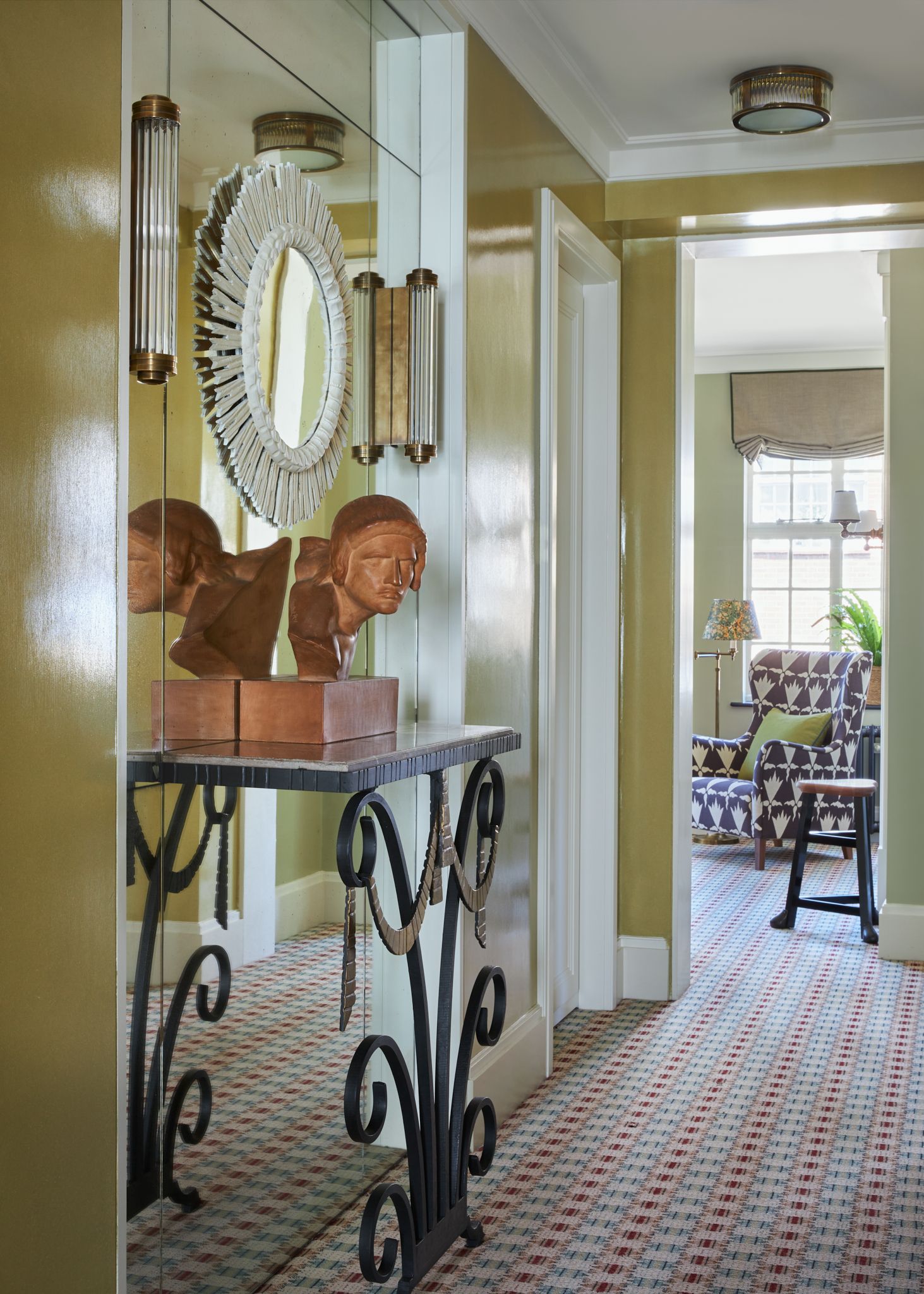
In the rest of the hallway beyond, Daniel has created an alcove for a console table and lined it in mirror glass, which is an idea we love in a hallway, as it helps create a sense of space and bounces light around. The rest of the walls are specialist painted in a stippled oil glaze lacquer (a treatment John Fowler loved). “It throws light around whilst avoiding the spray-on wet look that often is the fate of gloss walls,” says Daniel. In a small flat it's a good idea to have the same flooring running through as many rooms as possible – in this case the brussels weave carpet helps to connect the space to the sitting room beyond.
Carlos Garcia’s colourful coat and hat rack
In this flat in south London designed by Carlos Garcia, a compact entryway meant that Carlos ended up using pattern and colour as a vehicle to introduce liveliness to the space immediately behind the front door. “The rooms have to be comfortable and relaxing, but storage is never far from your mind,” Carlos told House & Garden of designing in a small dwelling – in this case, one of less than 50 square metres.

Given the flat is on an estate which Octavia Hill, the conservationist and founder of the National Trust, helped to mastermind, Carlos felt it was apt to include prints by Hill’s fellow Victorian thinker William Morris. As such, a curtain in Morris & Co’s olive/ochre ‘Little Chintz’ tones hangs behind the door. The panelling is in Fenwick & Tilbrook’s ‘Red Squirrel’ – a bright but unobtrusive shade which suits the size of the hallway – while the floor retains its original tiles.
In a small and potentially crowded hallway, there’s a difficult contradiction in that many flats need more storage space but have less room for it. An overhead shelf can be a clever answer to this paradox – it doesn’t impose on your ability to move easily in and out of the front door, particularly when you might be otherwise burdened.
Ben Pentreath’s unique Bloomsbury vestibule
The hallway in Ben Pentreath’s flat makes for a relatively constricted stairway, which nonetheless benefits from a high ceiling with a skylight. The flat is situation on the top floor of a peaceful Georgian building belonging to the Art Workers’ Guild, and needed renovating when he moved in; in return for a period living there rent-free, he agreed to redo it himself on the Guild’s behalf.

The hallway is an awkward shape, but framed artworks on the walls ensure the space is visually interesting and engaging, while on the right, a red chair (a Prince of Wales Investiture Chair from 1969 designed by the Earl of Snowdon) offers a pop of colour in a space that otherwise would be unused. The pendant light is ‘Beat Wide Black’ from Tom Dixon. An archaic, 18th-century-style yellow which looks a lot like Paper & Paint Library’s ‘Euphorbia’ on the walls gives the pleasing effect of walking into a salon such as the Royal Academy – albeit on a much smaller scale.


