

Few rooms look complete without art on the walls, and while individual paintings, photos and prints may look very lovely floating in their frames, how much more spectacular is a mural, literally art on the wall? From the dining rooms of Pompeii to the modernist salons of Paris in the 1930s, murals have provided a way to enlarge rooms, fool the eye, and immerse people in utterly different worlds. It may be an investment (unless your decorative painting skills are particularly on point), but it's the sort of statement you'll love forever (and it's bound to wow your visitors). If you're wondering whether to commission one and how to go about it, we've gathered some key points to consider.
What is a mural? Should I have one in my house?
Instagram content
Murals, simply put, are any versions of graphic artwork that is directly applied or painted on a wall, ceiling or other blank surface. The first known mural was one painted by our Paleolithic ancestors, the most famous being those in the Lascaux Cave in southern France. Since then, patricians of ancient Rome favoured murals as decoration for their glorious villas and the artists of the Renaissance were often commissioned to create large-scale works for rich citizens and clergymen alike.
Whilst murals of this nature are less common in today's decorative schemes, now largely manifesting as outdoor graffiti works, they are nevertheless still something to consider for your house. Why? Not only are murals are tailored to the commissioner, endowing walls with one-of-a-kind artwork unique to you and you alone, they also allow you to engage with artists on a personal level instead of via a gallerist or other art intermediary.
How long does the process take?
Instagram content
Surprisingly, not too long. Of course, the length of time required to paint one's mural depends on the scale, detailing and artist. For muralist Queenie Ingrams, the process usually takes “just under two weeks”, with the detail mostly dictating the time: “if you are creating a world, it can be 2D or 3D, but if you are just creating a foreground, it takes less time.”
Beyond murals, there are plenty of other ways to add decorative painting to one's home. Discover our favourite methods – and artists! – with which to adorn your walls like it's 1799. **
What can I have done?

It takes a “certain bravery to transform a space [with a mural]” says Queenie. Indeed, there is no end to what is in reach – wherever there is an expanse of blank, there is a chance for the creation of a beautiful, painted world.
Queenie's favourite projects are those that “celebrate or allude to a memory or place that is special to [her client]” and those emerging from an idea her client “has been thinking of doing for a long time, but has been hesitant to do.” However, if you're going all out with a mural, you can surely go beyond the personal confines of family memories and dare to create fairytale worlds or, even, something more abstract. When it comes to murals, anything is possible.
Those obsessed with a particular artist or movement, too, can use a mural to welcome the style into their home (without spending an arm and a leg at the auction house or gallery); on the rooftop terrace of journalist Pandora Sykes' London house, for example, artist Christabel MacGreevy painted a bright piece of suntanning women, reminiscent of the shapes and colours seen in the work of Henri Matisse.
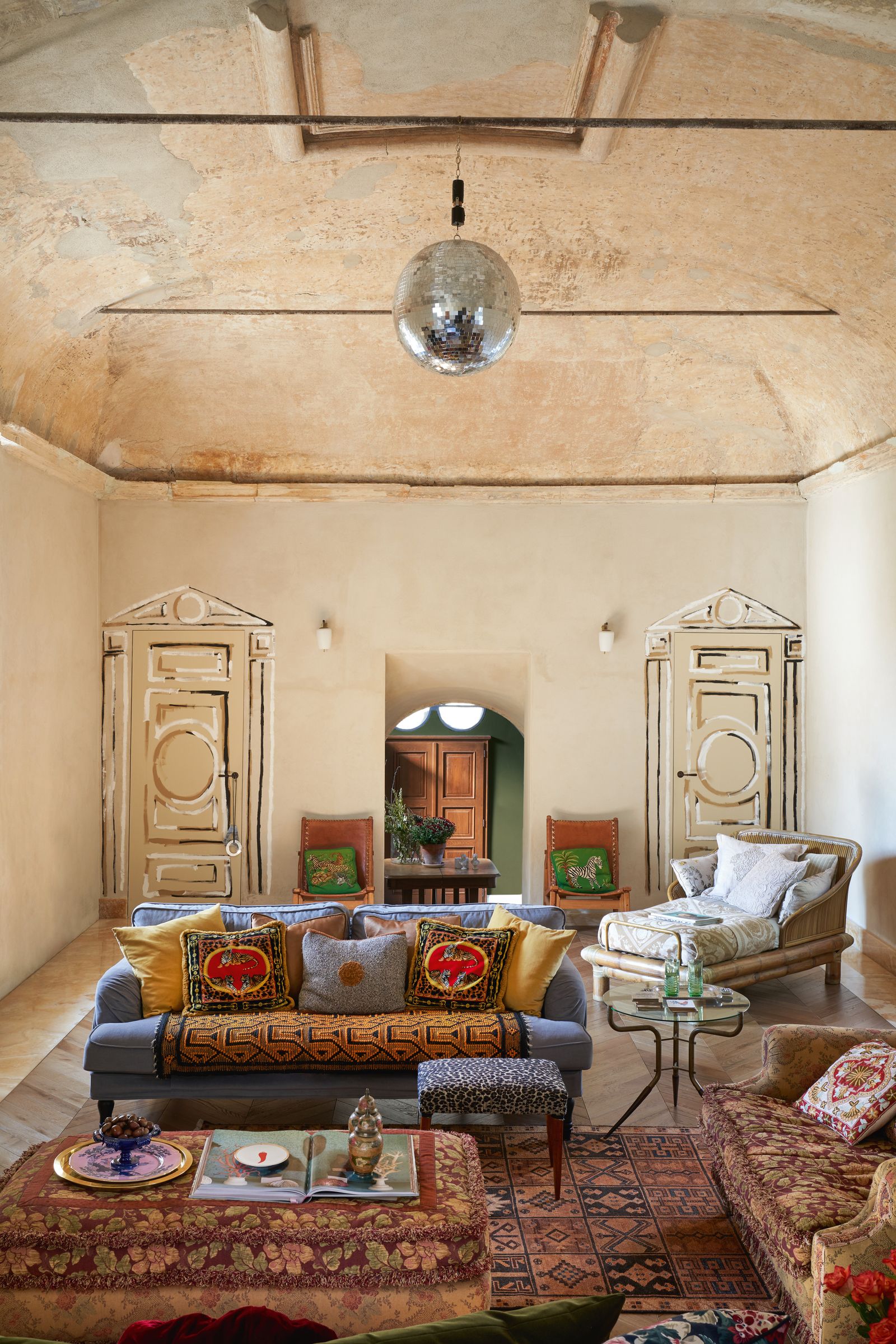
Another popular source of inspiration is the artist Christian Bérard, who was commissioned in 1939 by the interior designer Jean-Michel Frank to design trompe-l'oeil panelling for the Institut Guerlain in Paris. An esteemed painter and set designer - who had previously worked for Jean Cocteau, Coco Chanel and Elsa Schiaparelli - Bérard's design encapsulated a chic, playful originality that is wholly French. Made up of architectural details painted in white, black, mauve and grey brushstrokes to suggest shadow and light, Bérard then had grosgrain appliquéd on to yellow felt to represent his brushstrokes, creating a three-dimensional sculpture that resembled paint. These have inspired a myriad of copycat trompe l'oeil panels in stylish interiors, from the Hotel Peter & Paul in New Orleans to a heavenly Piedmont sitting room in our latest issue.
How do I add a mural to my interiors?
Instagram content
The first thing to consider is whether the architecture of the room is suitable for the type of work the client has in mind, as muralist Alan Dodd explains. From there, we talk about the style and period of design. It is often better to stay true to the style of the house, although occasionally a departure can work beautifully.
Certain rooms don't lend themselves to murals. Says Alan, “in my experience dining rooms, hallways and bathrooms are the best places to put them. In sitting rooms, you tend to have too much furniture, and people like bedrooms to be restful. But to have a mural in a dining room provides a talking point. They can create a real buzz. It is better to put them in communal areas where they can be enjoyed.”

'A mural differs to hanging art in that it creates a complete environment; in some cases, you could even say an extension of experience. Properly executed trompe l'oeil can work on quite a subliminal level. The height of the eye line is crucial. In a dining room, I will often lower the point of perspective because most people will be looking at it seated. In this way, you can make a small room feel inordinately bigger. I normally paint the light as it would fall in daylight, though sometimes painting it falling in the wrong direction can create an interesting tension.
“I use references, but I never copy. If I have a client that is Russian, for example, that will amend the way that I paint certain periods. I always think about how that style would be historically exaggerated and interpreted according to that culture. But murals should be commissioned outside of time and fashion. It is about enhancing a room's architecture. For a more subtle change, consider rusticated walls or trompe l'oeil panelling.”
If you're in the process of renovating your house, honing your vision for the mural before moving further in the design process is key. Choose a colour scheme and select the mural's subject, as both will help to create a cohesively decorated space, from mural to mantel to mirror. If you are working with an interior designer, make sure your muralist works alongside them; together, they “might create a vision you can't yet see,” advises Queenie.
If your house is already decorated and your colour scheme already chosen, keeping in line with one's original styling is probably the best option. Your muralist, too, will be available to offer advice for complementary colours to ensure that the new mural won't clash with its surroundings.


