


Currently on display at 6-7 Motcomb Street, Belgravia, is an exhibition of edible architectural models. At The Gingerbread City, there’s a Liquorice Library complete with 1553 books, a Milky Way Observatory with a dome and gracefully arched colonnades, and a Willy Wonka Wetland Centre where trees and ponds provide a haven for (also edible) wildlife. Alongside the disparity in function is stylistic variance: Cookie House Studios provides Victorian-era post-industrial space for artists, Mille-Feuille Square is Barbican-level aspirational, while the Tudor exterior of the Humbug Arms makes it look like the perfect pub for a post-work drink. If it all sounds a bit professional, rest assured that it is; the miniature urban landscape has been painstakingly put together by leading architects, landscape architects, engineers and designers, the whole endeavour organised by the Museum of Architecture around the theme ‘Designing for Different Climates’.
For gingerbread house enthusiasts, who attempt to assemble their own confectionary masterpiece every year, it’s a must-see – but chances are you’ll leave with one predominant question: how, and by what brand of magic, do these Gingerbread City creations look so good, when more amateur attempts so often collapse? The second, wider mystery is how have we got to a point where something that apparently started life in a Brothers Grimm fairy tale has become an essential ingredient of a traditional Christmas, widely available in kit form for those who can’t quite face starting from scratch?

That last has a more concise answer. The first known recipe for gingerbread came from Greece in 2400 BC; by the late Middle Ages, a European version was a staple at Medieval fairs in England, France, Holland and Germany. Queen Elizabeth I is credited with kickstarting the craze for shaping and adorning gingerbread biscuits with gold leaf – she had some made to resemble dignitaries visiting her court, whereupon elaborately decorated gingerbread became synonymous with elegance in England. At the same time, gingerbread houses were becoming popular in Germany, decorated with foil as well as gold leaf, and these became associated with Christmastime. Fast-forward to the publication of of Hansel & Gretel in the 18th century and those gingerbread houses, now decorated with sweets, went mainstream; it would seem we all enjoy getting one over on the witch by gobbling up her enticing lodgings. And certainly the scent of gingerbread is wonderfully evocative, which is reason enough to make one – and reason enough to ask some of the architects, and other gingerbread experts, for tips.
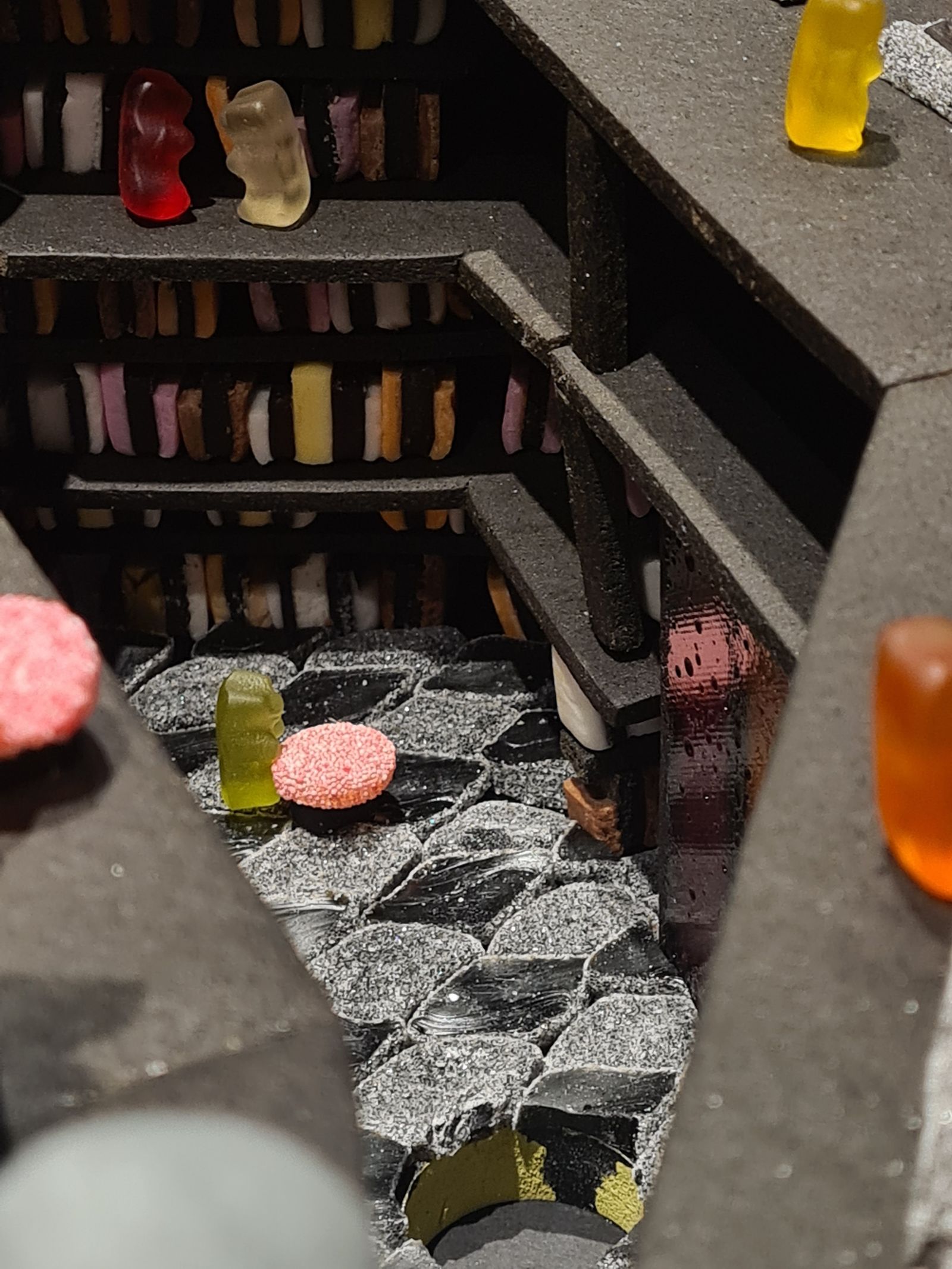
The obvious starting point is a recipe for a sufficiently solid gingerbread; nobody wants sagging walls, and cracks are as much a structural problem in sweetmeats as they are in real life. Emily Garland works under the name of Maid of Gingerbread and creates rather phenomenal gingerbread sculptures; Jenny Simpson, Design Director of Chelsea Textiles, once commissioned her to recreate thher family’s 18th century house in Oxfordshire, and she has also made an edible replica of Castle Howard. She notes that while there are a wealth of different recipes available, you have to “use one designed for 3D building, rather than 2D gingerbread men.” What might also be worth taking into consideration is the extent of your talent. “I definitely see myself more as a designer-maker who happens to work with food, rather than a ‘baker’,” says Emily. And Joseph R. Goodwin, who led the team at architectural and design studio UHA in creating the Liquorice Library, reveals that “first we modelled the full building in 3D on screen, then in card to make sure it would stand up, and then, before assembling the final Library, we sanded down the surfaces to make them all level. So it was quite arduous.”
Instagram content
Also vital is the icing – or whatever you use to persuade the pieces to stay together, for there are people who swear by caramel, and “I like how it is so quick to hold,” says Emily, “but ultimately it doesn’t last as long in display pieces and is tricky to work with.” She prefers royal icing, “take your time making sure you have it at the right consistency,” she advises, mentioning that she occasionally dyes it the same colour as the gingerbread, for clean-looking joints. But the sticking business can be frustrating, however many small jars and tins you’ve got on hand to prop up your walls – and “we used a glue-gun,” confesses Jenny Stevens of Hopkins Architects, the firm behind the Pop Rock Ponte in this year’s Gingerbread City. She tells me that she’s tried to make a proper one before but “it’s so hard! They don’t stay together!” (It should be noted that superglue is admissible for entries to this exhibition – not least because the buildings need to stay standing for a while.) “A lot of it is about patience,” admits Jenny.

But, if you do master the structure, the fun starts – with the decorating. Although even here, “we’ve found it’s often best to err on the side of simplicity,” says Joseph. “Sweets that have a more definite shape and are slightly stronger are better,” says Jenny. “They tend to look more like jewels, whereas softer sweets are not as easy to deal with.” She advises using Isomalt instead of sugar for areas of water or stained-glass windows (you can add food colouring), “sugar is less stable, so it’s harder to get the melting temperature right without it burning.” Then, remember the benefits of a piping bag, and the convenience of tweezers – and know that if you do want to up your game, The Gingerbread City is running family workshops, from which you can “take home your very own futuristic house with solar panels and a green roof.”
But, it’s supposed to be enjoyable. We haven’t all got 400 spare hours in Advent (the time Joseph estimates it took to design and assemble the Liquorice Library) and there is nothing wrong with scaling your ambition in line with whatever you can find ready for assembly on Amazon. So put on the Christmas carols – which is what Jenny and her team listened to while building - and remind yourself that, if the worst does happen, a gingerbread wreck-resembling renovation project will taste just as delicious as a gingerbread Georgian mansion.


