

A certain discreet industry insider (let’s call him Simon) with a determination to furnish his flat in perennial style, but also on a budget, recently described his brilliant plan to take as inspiration Lawrence Seldon’s rooms in Edith Wharton’s The House of Mirth. There was to be ‘a hall hung with old prints’, ‘a small library, dark but cheerful, with walls of books, a pleasantly faded Turkish rug’, and ‘a fresh scent of mignonette and petunias from the flower-box on the balcony’. The novel, one of Wharton’s magnificent Gilded Age chronicles, was published in 1905 and is set in the 1880s – but Lawrence’s rooms are as timelessly appealing now as they were then, and it was not an expensive scheme.
While the grandest interiors tend to last by being passed down through generations of a family who would never throw out the Chippendale or part with the Gainsborough, it can be harder to find more attainable real-life rooms of age. This is for the simple reason that they are ephemeral: houses are sold, and the next owners do something quite different. And so writers of taste who described such scenes are of value (let’s not forget that Wharton also wrote The Decoration of Houses – which is still referred to by interior designers today). Paintings of interiors also merit study, while later, we have colour photography, which makes the job easier. The job being to identify the items whose worth has, over the passage of time, been proven to be greater than their cost.
Specifically, that is the furniture and furnishings that will always prove a wise purchase for those of a similar school of thought to Simon. These classically lovely pieces will never go out of style, and can be transported between homes and adapt to each without ever wearing out or ceasing to be useful. If anything, their value to us will only increase (it’s the opposite of driving a new car out of a showroom), not only in adding to a room’s patina, but because they’ll become part of our story. To return to Lawrence Seldon, it’s the Turkish rug, the books, and the old prints – but there’s more besides. Listed below are seven examples that, put together, could form the basis of a perfectly charming interior.
A brass bed

Many of us discovered the (literal) magic of brass bedsteads through Mary Norton’s delightful children’s books - or the film, Bedknobs and Broomsticks, that was based on them. The story was set during the Second World War; fast forward to now, and Alexandra Tolstoy has brass bedsteads both in her house in London and at her charming Oxfordshire cottage (the children’s bedroom has three in a row), George Saumaurez Smith has one in his spare bedroom, Remy Renzullo sleeps in one – I could go on. They’re particularly attractive when accessorised with pretty linens and quilts, can be combined with a half-tester or canopy if you so desire, and are (mostly) free from the fussiness that befell some Victorian designs. For Victorian they are; also known as ‘French beds’, they started being made in around 1840 and increased in popularity as the century progressed.
Then, much of the attraction lay in their being cheap to make (industrial advances had improved the quality and decreased the price of such metalwork), manageable to move around (also used in hospitals, they were set on castors) and easy to clean. At a time when disease was rife and infant mortality was high, and Florence Nightingale’s ideas about hygiene were being adopted, this mattered. (It’s still relevant: would you buy a 140-year-old upholstered headboard without knowing a lot about its provenance?) Most of the bedmakers were Birmingham based, and some examples were extraordinarily elaborate: at the Great Exhibition of 1851, a brass bedstead by R W Winfield was described as having ‘metal work in the Renaissance style, with figures, foliage and scroll work’. Those intended for the poorer public, or for use by servants, were plainer, and more likely to be made mostly in cast iron (painted black or white) with a brass top rail and finials to adorn the posts. Such was socio-economic landscape that there were a far greater quantity of the latter made – and thus a greater quantity of the latter that are available now, from antiques shops, antiques markets, Vinterior, and more.
An Oriental rug

The world ‘oriental’ comes from the Roman reorganisation of the provinces of West Asia and North Africa as the Diocese of Oriens in 314 AD (‘oriens’ meant ‘East’, so ‘east of Rome’) making this a catch-all term for carpets from a wide range of origins. But they pre-date the Roman Empire’s eastern expansion: in the 1940s, a 5th century BCE Pazyryk rug was discovered, proving their durability. They’ve been incorporated into English interiors since the Crusades – they feature in Holbein’s portraits of Henry VIII – and for the great Robert Kime, they were the beginning of every interior: he’d base a whole scheme around their colours.
They are still being made (not always by hand these days) but the antique variety are more valued, partly because they’re prettier when slightly faded, as in Lawrence Seldon’s study. But also, age helps with a room’s layering, grounding it – however new any other textiles might be. ‘It’s as if they bring some of their past existence with them,’ says Roger Jones, director at Sibyl Colefax & John Fowler. There’s huge range in size, palette and price – happily specialist Louise Broadhurst has advised on what to look for.
Blue and white china

There’s a democracy to the ubiquity of blue and white china. It’s a recurring prop in paintings by many 19th- and 20th-century artists, in interiors that run the full gamut from humble to very grand (James Gunn painted the royal family having tea in the Royal Lodge). Flick through any copy of House & Garden and chances are you find more than one instance of its presence. Originally invented in China during the Tang dynasty (618 – 906CE), blue and white china is one of the most widely re-created types of china in the world.
And no wonder, for blue and white china – like a blue and white scheme – has eternal appeal. Whether high in value (and oh it can be high) or collected piecemeal and mismatched from junk shops, it looks very pretty laid on a table, stocking a dresser, or propped on a shelf above the Aga. There’s diversity: Willow pattern is one of the most popular forms, originating c1780 in England, and still being made by several companies including Burleigh. It features set characteristics of a pagoda, three figures on a bridge, a figure in a boat, two flying birds and a weeping willow tree. ‘Asiatic Pheasant’ is another classic, while Cornishware offers bold stripes, and Gavin Houghton makes more contemporary reimaginings. As hinted at earlier, it’s not just about tableware: there are urns and vases, lamp bases and washing vessels. Plates can migrate from the table to the wall (they’re ideal decoration for bathroom or a kitchen as they withstand steam and damp) which is how Gavin displays the Delft he used for dinner parties as a student, not realising then how precious it was.
A gateleg table

The term ‘gateleg’ dates to the 19th century, but the style of table itself is older, having its origins in 16th-century England and Holland, when houses did not have dedicated dining rooms. Tables would be set up for meals, and then put away. Also known as ‘drop leaf’ tables, they only increased in popularity over the next two centuries, as even when dining rooms were adopted, many had a collection of smaller tables instead of one big one. And so gateleg tables regularly feature in paintings of both English and Dutch interior scenes (though you can’t always distinguish them, as often they’re covered by a tablecloth.)
Today, they’re ideal for those of us who are pushed for space and looking for adaptability in our furniture – such as a table that can seat up to eight, and then fold down and be put flat against a hall or bedroom wall as a console. Typically they’re oval in shape when fully employed (rectangular versions also exist), made from English oak (though there are some in yew or walnut) with sturdy legs that might be bobbin-turned or barley twist. Nineteenth- and early 20th-century gateleg tables tend to be very affordable (you can still get them for under £200), but they go up in price with age, condition and shapeliness of leg. Either way they’re attractive, solidly unpretentious, suit a variety of interiors and, to reiterate, take up very little space when not in use. Examples can be spotted at Kettle’s Yard, in Adam Bentley’s 17th-century cottage, Remy Renzullo’s Chelsea cottage, and in Jeremy Langmead and Simon Rayner’s house in the Lake District – in the library that doubles as a dining room.
Prints and paintings
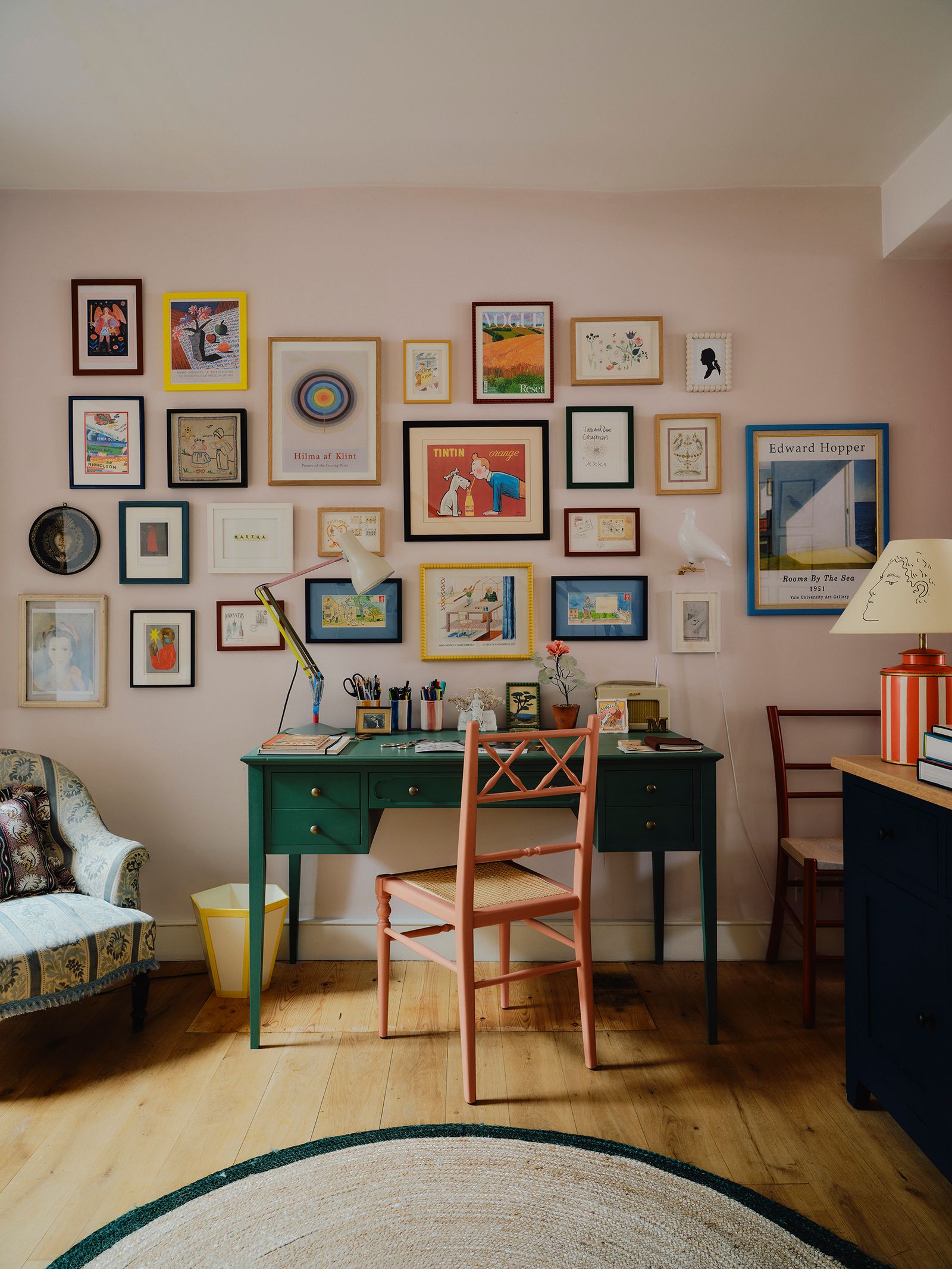
In the 1930s, the writer Rosamond Lehmann had near-cult status. The founder of publishing house Virago, Carmen Callil, described Lehmann’s character Olivia Curtis as her generation’s Bridget Jones. There’s a moment in The Weather in the Streets, published in 1936, when Olivia is looking around her bedroom, examining it as if through the eyes of Rollo, the man she is in love with. ‘He must think everything nice,’ she worries. Reassurance comes from a painting she’s hung, ‘of people sitting on park chairs under a plane tree’ that she bought ‘at the London group’. Lehmann, incidentally, was Nina Campbell’s first-cousin-once-removed, and ‘had tremendous style’, says Nina.
Almost without exception, the houses that feature between the page of House & Garden are hung with art – a practice that dates to 3,500 BCE, and cave painting. But art does more than decorate; it is part of a room’s layering, and it’s companionable. If you’re someone who moves often, a familiar work can make anywhere feel like home. Prints are one of the most egalitarian form: whether engravings, etchings, lithographs or woodcuts, their being produced in multiples brings the cost down. Michael Finney deals in the antique variety, which yet can be startlingly low in price. For more modern iterations, the Woolwich Contemporary Print Fair in November is a cornucopia of discovery. At the same time, good, original art can transform a room in the way Lehmann described, elevating the ordinary with the focus it draws. Prices vary wildly – but there is advice available, and much that is affordable, both new and old.
An antique textile

Once upon a time, ‘when warfare and brigandage shaped the conditions of life, and men camped in their castles as much as they did in their tents, it was natural that decorations should be portable,’ wrote Edith Wharton in the aforementioned The Decoration of Houses, singling out wall hangings. We may have calmer itineraries now (at least in terms of where we lay our heads at night) but many of today’s interior designers will always include an antique textile in a scheme. Whether a suzani, a French 17th-century piece of embroidery, or a length of striped silk, designers including Joanna Plant, Veere Grenney and Rita Konig know how well they work.
They add to a layered aesthetic, and soften a scheme while bringing colour and pattern – but they’re also extraordinary versatile, so having one or two such cloths up your sleeve pays dividends. Yes, they can be hung from the wall as art, but they can also be employed as a curtain, a bedspread, a tablecloth – or, as Katharine Pole suggests, draped over a staircase, or arranged over the back of a sofa or chair. Katharine deals in French and French-sourced fabrics from the 18th, 19th and early 20th century. Susan Deliss has some exquisite suzanis (which originate in central Asia) – and more are to be found at antiques markets both in the UK, and on the continent.
A piano

Invented c1700, pianos were once so omnipresent that Jane Austen (who herself was an accomplished pianist) employed them as plot devices. They’re the subject of numerous paintings, too – by such names as Berthe Morisot, Henri Matisse and Edward Hopper. Since then, our home-entertainment choices have broadened, an ability to play is no longer seen as an essential life skill, and many see a piano as taking up too much precious space. But for those of us who can find a spot, a piano brings great joy, for it holds within it the possibility of music, singing, and more. Jane Austen believed regular playing improved her ability to write.
Artist Robert Montgomery and poet and filmmaker Greta Bellamacina have a grand piano in the music room of their Kent home – and a dedicated music room is a charming idea. But for those with less space, an upright is lower on footprint, while bequeathing whichever room it’s in an additional shelf for treasure. There are numerous sites that deal in second hand pianos, but the miracle – or tragedy depending on which way you look at it – is that if you look in the right places (Facebook Marketplace, Freecycle) you can generally find an upright piano being given away. It might need tuning.


